
Mounjaro10 min read31 August 2026
Not losing weight on Mounjaro: what now?
You have been using Mounjaro for a few weeks and the scales are not moving, or have stopped moving. That is frustrating, especially if you expected a lot from it. The most common explanation is a dosage that is still too low or a build-up phase that is still under way. After that come eating pattern, consistent use, a plateau and, less often, a medical cause.
 By Nagita Grover-Khatri
 Medically reviewed by Nazanin Ahmadi Mozafari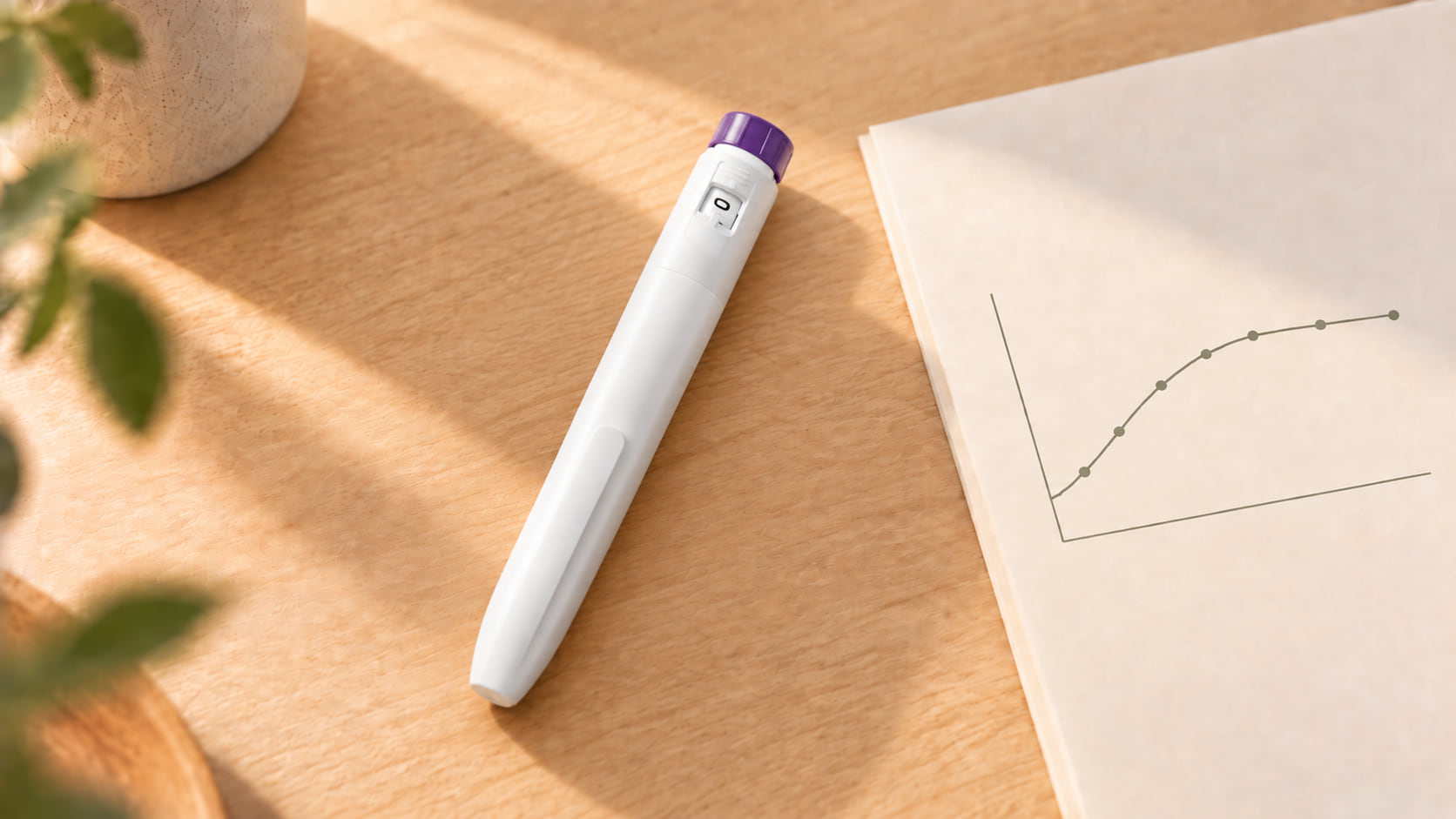
Not losing weight on Mounjaro? These are the most common causes
Not losing weight on Mounjaro usually has one of six causes: you are still in the build-up phase, your dosage is too low, you are not using or storing the pen correctly, your eating pattern is working against you, you have hit a plateau, or something medical is playing a part. A small group notices little effect. Read more about Mounjaro vs Saxenda.
That last group does exist. In the SURMOUNT-1 study, published in The New England Journal of Medicine, the vast majority of participants on tirzepatide lost at least 5% of their body weight in 72 weeks, but a small proportion did not. Before you conclude that you belong to that group, go through the other five causes first. In most cases, the explanation lies there.
Below you go through the causes in the same order as the doctor does: build-up phase, dosage, injection and storage, lifestyle, plateau and medical factors. For each cause you can read what you can do yourself and what the doctor can adjust. Mounjaro contains the active substance tirzepatide. Read more about the Mounjaro golden dose.
You are still in the build-up phase: how long does it take before Mounjaro works?
In the first 4 weeks you use 2.5 mg per week, a dosage intended to let your body get used to the medication and not to make you lose weight. For most people, measurable weight loss only starts after 4 to 8 weeks, around the switch to 5 mg. If you "notice nothing" after 3 weeks on the starting dose, you have not reached the end of the treatment; you have not really started yet.
Even on 5 mg, the effect is still limited for some people. The full effect comes at a higher dosage, after a few months. What you can expect at each stage is in our article how fast does Mounjaro work after injection.
Your dosage is still too low
The most common reason Mounjaro does little after the build-up phase is a dosage that is still too low for you. The schedule according to the Farmacotherapeutisch Kompas (the Dutch national drug formulary) of Zorginstituut Nederland (the Dutch National Health Care Institute): start with 2.5 mg, after 4 weeks 5 mg, and then, if needed, increase in steps of 2.5 mg after at least 4 weeks each time, up to a maximum of 15 mg.
Not everyone needs the highest dosage, but if you notice no effect on 5 mg after 8 to 12 weeks, you are usually ready for the next step. The doctor makes that decision, based on your weight trend and your side effects. Never increase the dose yourself; the gradual build-up is there to limit nausea and vomiting.
Sometimes the opposite is the case: someone stays on a higher dosage with many side effects, eats poorly and irregularly as a result, and for exactly that reason does not lose weight. Here too, the dosage is worth discussing with the doctor. The full schedule is in our article on Mounjaro dosage.
Injection, storage and consistent use
Mounjaro only works if the full dose enters your body every week and the pen has been stored correctly. Three things regularly go wrong in practice:
- Missed or delayed injections. According to the Farmacotherapeutisch Kompas, you should still take a forgotten dose within 4 days; after that, you skip it. If you regularly skip a week, you do not keep a stable level in your blood and notice less effect.
- Incorrect storage. Before use, the KwikPen belongs in the fridge at 2 to 8 °C and must not freeze. A pen that has been in the sun, in a hot car or in the freezer can lose its effect without you being able to see it.
- Injection technique. According to Apotheek.nl, the patient information website of the Dutch pharmacists' organisation KNMP, you inject once a week under the skin of your abdomen, thigh or upper arm, and the liquid should be clear and colourless. Injecting too shallowly, leakage when pulling the needle out or always using the same spot can reduce absorption.
If you are unsure whether your pen works properly or has been stored correctly, check with the pharmacy. How to set the dose, inject and store the pen is explained step by step in our article on the Mounjaro pen.
Eating pattern, exercise, sleep and stress
Mounjaro takes away the feeling of hunger, not the calories you consume out of habit, sociability or stress. If you are less hungry but keep eating the same, you will not lose weight. The most common pitfalls: liquid calories (soft drinks, juice, alcohol, coffee with milk and sugar), snacking out of habit, large portions "because you can" and too little protein. Read more about Mounjaro and alcohol.
That last point deserves attention. The Voedingscentrum (the Netherlands Nutrition Centre) advises healthy adults to eat 0.83 grams of protein per kilo of body weight per day, and points out that enough protein during weight loss limits the loss of muscle tissue. Muscle tissue uses more energy than fat tissue; if you lose muscle, your metabolism falls and in the long run you lose less weight. You can find practical guidance in our Mounjaro diet plan.
Exercise, sleep and stress do the rest. Strength training twice a week protects your muscle mass. Lack of sleep and persistent stress raise hunger hormones and cortisol, and make your body hold on to fluid and fat. The medication then works against the current.
Would you like a doctor to look at what is going wrong with you? In a few minutes you will know whether medical weight loss could suit you; the doctor then assesses your application. Eligibility check →
Did Mounjaro work at first but not any more? The plateau
If Mounjaro worked well at first and your weight has now stalled, you have probably hit a plateau. That is not a sign that the medication has stopped working. After a period of weight loss, your body adapts: you use less energy because you are lighter, and your metabolism temporarily drops a little further than your weight alone would predict.
Three things help with a plateau. First, patience: in studies, weight loss often continues after a standstill, more slowly. Second, a check of your eating pattern, because portions quietly grow again once the nausea of the build-up phase has gone. Third, a conversation with the doctor about the dosage: sometimes a next step is the answer, sometimes not.
A plateau after 10 or 15 kilos is something different from never getting results. How to deal with that stubborn last stage is in our article on how to lose the last few kilos.
No hunger, but no weight loss either
Having no hunger and still not losing weight does happen, and the explanation almost always lies in what you eat and drink despite the lack of hunger. Tirzepatide suppresses the physical hunger signal; it does not suppress the habit of eating while making coffee, while cooking or in front of the television.
Keep track of what you eat and drink for three days, including drinks and nibbles, without changing anything. Energy intake often turns out to be higher than you thought, with liquid calories as the biggest item. On the other hand, do not eat too little: if a lack of hunger makes you drop to one meal a day, you lose muscle mass and get too little protein, which harms your metabolism in the long run.
The reverse also applies: being hungry on a low dosage is normal and says nothing about the eventual effect. For most people, the effect on appetite only really gets going from 5 or 7.5 mg.
When should you talk to your doctor about adjusting, switching or stopping?
Talk to your doctor if you see no weight loss after 8 to 12 weeks on a dosage of 5 mg or higher, if the side effects get in the way of eating and drinking, or if your weight has stood still for longer than 6 to 8 weeks after a good start. The doctor then goes through the causes above and looks at medical factors that work against weight loss.
| Signal | Possible cause | What you do yourself | When you speak to the doctor |
|---|---|---|---|
| No effect in the first 4 weeks | Build-up phase on 2.5 mg | Wait, build up your eating pattern | At the scheduled check-up |
| No effect after 8 to 12 weeks on 5 mg | Dosage too low | Keep a food diary | Discuss the next step |
| Standstill after earlier weight loss | Plateau, portions have grown | Check eating pattern and exercise | If the standstill lasts longer than 6 to 8 weeks |
| Less hunger, no result | Liquid calories, eating out of habit, too little protein | Write everything down for three days | At the next check-up |
| Many side effects, poor eating | Dosage increased too quickly | Small, protein-rich meals | Soon: adjust the dosage |
| Weight gain despite use | Other medication, thyroid, fluid | Bring your list of medicines | Straight away |
Medical factors the doctor checks: an underactive thyroid, medicines that cause weight gain (some antidepressants, antipsychotics, corticosteroids, insulin and beta blockers), PCOS, menopause and fluid retention. You can read more about this in our article on medical conditions that prevent weight loss.
Switching to another medication or stopping only comes into play once the causes have been checked and a higher dosage makes no difference. You then stop in consultation with your doctor and step by step; how that works is in our article on stopping Mounjaro. With us, this whole process runs through your own doctor in the programme medical weight loss with injections.
Would you rather lose weight with a doctor who steps in when progress stalls? The doctor assesses whether medical weight loss suits you and tailors the dosage and plan to you. Medical weight loss with injections →
Frequently asked questions about Mounjaro not working
Why is my Mounjaro not working any more?
Usually because of a plateau: after a period of weight loss your body uses less energy and portions quietly grow again. Other causes are missed injections, an incorrectly stored pen, more liquid calories, or stress and lack of sleep. Discuss it with your doctor before changing the dosage yourself.
What can cause you not to lose weight?
The most common causes are a build-up phase that is still under way, a dosage that is too low, an eating pattern that works against the effect, missed doses and a plateau. Less often, medical factors play a part, such as an underactive thyroid or medication that causes weight gain.
How long does it take before Mounjaro works?
Most people notice less appetite in the first week. Measurable weight loss usually follows after 4 to 8 weeks, around the switch from 2.5 mg to 5 mg. The full effect comes at a higher dosage, after a few months.
Why am I not hungry on Mounjaro?
Because that is exactly what the medication does: tirzepatide suppresses the hunger signal and slows gastric emptying, so you feel full sooner. Not being hungry does not mean you do not need to eat; eat three small meals with enough protein to maintain muscle mass.
What is a realistic pace?
Doctors consider half a kilo to one kilo per week to be responsible. Losing weight faster increases the loss of muscle mass. In the SURMOUNT-1 study, participants lost an average of 16 to 22.5% of their body weight in 72 weeks, depending on the dosage; that is an average and varies from person to person.
Does the same apply to Ozempic?
Largely, yes: the build-up phase, dosage, eating pattern and plateau play a part with every GLP-1 medication. The dosages and pace differ. For that, read our article Ozempic not working for me.
<!-- klant:eind -->Responsible for this information: Qlinic B.V., Markenhaven 25A, Amersfoort. Published: 31 August 2026. This article is general information and does not replace personal medical advice.
About the author
Nagita Grover-Khatri
Doctor · BIG 39912467601
Focuses on medical programmes for overweight, with attention to the person behind the numbers.
More about Nagita Grover-Khatri
Further reading


Mounjaro · 10 min
Mounjaro diet plan: what to eat and what to avoid, with a daily menu and recipes
By Nazanin Ahmadi Mozafari, doctor

Mounjaro · 10 min
Stopping Mounjaro: tapering off, what happens and how to keep the weight off
By Nazanin Ahmadi Mozafari, doctor

Mounjaro · 9 min
Tirzepatide: the active substance in Mounjaro
By Nazanin Ahmadi Mozafari, doctor