
Mounjaro9 min read3 September 2026
The Mounjaro golden dose: what is left in the pen, and why don't you use it?
After your fourth injection, you can still see liquid in your Mounjaro pen. On TikTok and Reddit this is called the "golden dose": a free fifth dose. You wonder whether that is true, and whether you can use it.
 By Nagita Grover-Khatri
 Medically reviewed by Nazanin Ahmadi Mozafari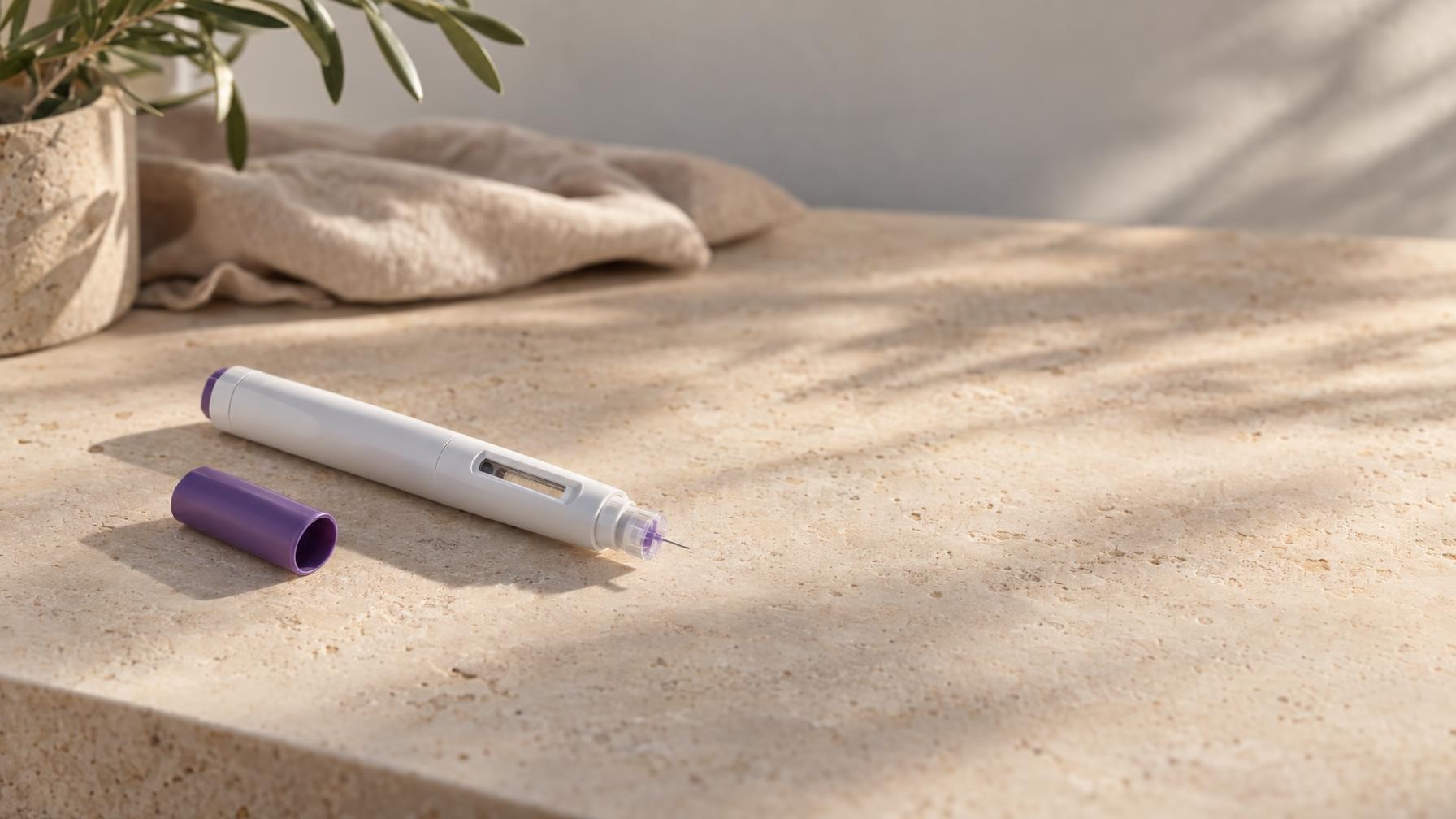
What is the Mounjaro golden dose?
The golden dose is the name users give to the liquid that remains in the Mounjaro KwikPen after the four prescribed weekly doses. Each pen contains 2.4 ml of solution for four doses of 0.6 ml, plus a small overfill. On social media, tips circulate on using that overfill as a fifth dose, with a separate syringe or by resetting the pen. That has never been tested, is not approved and is explicitly advised against by the manufacturer.
The term suggests a hidden gift. In reality it is a technical reserve that comes with every prefilled multi-dose pen, including insulin pens and other GLP-1 pens. The difference is that Mounjaro is expensive, which is why the search "how do I get the fifth dose out" became popular. Read more about Mounjaro vs Saxenda. Read more about Mounjaro vs Wegovy. Read more about Mounjaro.
Why is there liquid left in the KwikPen?
Liquid remains because the pen deliberately contains more than four doses. The Mounjaro product information from the European Medicines Agency says it literally: each pen "has an overfill of volume for priming. However, an attempt to inject any remaining medicine will result in an incomplete dose, even though there is still medicine in the pen."
Priming is the key. Before each injection, you turn the dose knob to the priming symbol, tap air bubbles to the top and spray a little medicine into the air until you see a drop at the needle. That way you know the needle is open and the pen works properly. Those four primings together use up medicine, and that is what the overfill is for. So what remains after the fourth dose is what is left over after four primings, not a measured fifth dose.
On top of that, after the fourth dose the pen's mechanism can no longer be set to a full dose. If you still extract the remainder, you do not know how much is in the syringe, or whether there is air in it.
Why doctors and the manufacturer advise against the fifth dose
The fifth dose is not advisable because you do not know the amount, you break sterility and you step outside all research. These are not theoretical objections; this is what they look like in practice.
| What people hope | What happens |
|---|---|
| "There's still a whole dose in there" | The pen contains an overfill for four primings; the remainder varies and is usually less than one dose |
| "I'll just draw it up with an insulin syringe" | The cartridge is not designed to be pierced; risk of air, contamination and the wrong amount |
| "A little too little doesn't matter" | Underdosing undermines your schedule; your body gets less that week than the doctor intended |
| "A little too much doesn't matter" | At a higher dosage than agreed, nausea, vomiting and the risk of dehydration increase |
| "This saves me a week" | You disrupt the weekly rhythm and the build-up, and your doctor does not know what you are actually using |
| "It's the same substance anyway" | True, but the safety of tirzepatide has only been studied in measured doses from an intact pen |
Side effects that a wrong dose can trigger are in our article on Mounjaro side effects. The Nationaal Vergiftigingen Informatie Centrum (NVIC) (the Dutch Poisons Information Centre) reported in June 2026 that the number of poisonings with weight loss medication doubled in 2025 to 149; in 40% of the reports concerning GLP-1 medications, no doctor was involved. Dosing yourself outside the schedule belongs in that category.
Does your dose feel too low? This is the safe route
If you are looking for the golden dose because your dose no longer seems to do enough, or because you want to make your pens last longer, the doctor is the route, not the leftover liquid. According to the Farmacotherapeutisch Kompas (the Dutch national drug formulary) of Zorginstituut Nederland (the Dutch National Health Care Institute), you start with 2.5 mg per week, move to 5 mg after 4 weeks, and the doctor can then increase in steps of 2.5 mg, after at least 4 weeks each time, up to 15 mg. So a dose that feels too low is a signal to discuss the next step, not to top up yourself.
Three situations are common:
- You have just moved to a new dosage and your appetite returns a little after 2 to 3 weeks. That is normal; the doctor assesses after 4 weeks whether you go up. Read more about this under Mounjaro dosage.
- You have been on the same dosage for months and are no longer losing weight. Discuss an increase or a different approach; see not losing weight on Mounjaro.
- It is about the cost. Stretching a pen further seems like a saving, but a disrupted schedule costs you results. The actual price per dosage is in Mounjaro price; discuss with the doctor whether a lower maintenance dose is an option for you.
With us, that decision is part of the programme medical weight loss with injections: your own doctor evaluates your dosage every 4 weeks and adjusts it.
Not sure whether your dosage is still right? With medical weight loss with injections, your own doctor adjusts the dosage, so you never have to improvise yourself →
How the Mounjaro KwikPen works: four doses in four weeks
One Mounjaro KwikPen lasts four weeks: one dose per week, four doses per pen. Each pen contains one strength (2.5 to 15 mg per dose). You keep the pen in the fridge; outside the fridge it can be kept for a total of 21 days at a maximum of 30 °C. After first use, you throw the pen away after 30 days, even if there is still liquid in it.
In broad terms, an injection goes like this: attach a new needle, prime (dose knob to the priming symbol, tap, spray a little medicine into the air), turn the dose knob until it stops and the dose shows in the window, inject into the abdomen, thigh or upper arm and keep the button pressed while you slowly count to 5. Then remove the needle and put it in the sharps container.
You should still take a missed dose within 4 days; after that, you skip it and continue on your usual day. The full instructions for use, with photos for each step, are in our article on the Mounjaro pen.
The modified KwikPen: what changes?
The manufacturer has announced that it will modify the KwikPen so that hardly any visible liquid remains after the fourth dose. According to reports from pharmacies and clinics, this involves a longer internal plunger that is visible at the end of the cartridge after the fourth injection, with roll-out from April 2026. For you, nothing changes in how it works or in the dosage; the pen simply shows more clearly that it is empty.
Separately, the British regulator MHRA warned in February 2026 about counterfeit 15 mg Mounjaro KwikPens that had been supplied through an online pharmacy; the dose knob came loose during use. A pen that looks or works differently from what you are used to is a reason to call the pharmacy. So only buy Mounjaro through a doctor, a prescription and a recognised Dutch pharmacy; how that route works is in how to buy Mounjaro.
What do you do with an empty or stuck pen?
An empty pen, including any remainder, goes into a sharps container or follows your pharmacy's instructions. Not in household waste. You use needles once and put them in the container straight after the injection.
If the dose knob does not turn as far as the symbol in the window, then according to the patient information leaflet there is not enough medicine left in the pen for a full dose. Throw the pen away, including the unused medicine, and do not try to inject the remainder. If the button is hard to press, press more slowly, or replace the needle (it may be blocked) and prime again. If there is dust or moisture in the pen, throw it away and take a new one.
If you miss a dose because of a faulty pen, report this to your pharmacy and your doctor. The pharmacy can replace the pen and the doctor knows that your schedule had a hiccup.
Would you like to know whether medical weight loss is right for you? Take the eligibility check and the doctor will assess your situation →
Frequently asked questions about the Mounjaro golden dose and the Mounjaro pen
What should you do with an empty Mounjaro pen?
Put it in a sharps container or follow your pharmacy's instructions, with the remainder inside. Not in household waste and do not keep it for later: 30 days after first use or after the fourth dose, the pen is finished.
How do I prime the Mounjaro pen?
Turn the dose knob until you hear 2 clicks and the long line appears in the window, hold the pen with the needle pointing up, tap the air bubbles to the top and press the button until you see a drop at the needle. If you see nothing, repeat a maximum of 2 times and otherwise use a new needle.
How long does 1 Mounjaro pen last?
Four weeks: one dose per week, four doses per pen. After first use, the pen must be thrown away within 30 days, even if there is still liquid in it.
My Mounjaro pen won't turn any more. What should I do?
If you cannot turn the dose knob as far as the symbol, there is not enough medicine left for a full dose. Throw the pen away and take a new one; do not try to inject the remainder. If in doubt, call your pharmacy.
Is the golden dose dangerous?
It is an unknown, non-sterile and untested dose. You risk underdosing or overdosing, air bubbles and contamination. The patient information leaflet, the manufacturer and doctors advise against it. If your dose feels too low, discuss a dose increase with the doctor.
<!-- klant:eind -->Responsible for this information: Qlinic B.V., Markenhaven 25A, Amersfoort. Published: 3 September 2026. This article is general information and does not replace personal medical advice.
About the author
Nagita Grover-Khatri
Doctor · BIG 39912467601
Focuses on medical programmes for overweight, with attention to the person behind the numbers.
More about Nagita Grover-Khatri
Further reading

Mounjaro · 15 min
Mounjaro side effects: what to expect (and what you can do)
By Nazanin Ahmadi Mozafari, doctor
Mounjaro · 8 min
Mounjaro price: what you pay per month in the Netherlands (2026)
By Nazanin Ahmadi Mozafari, doctor
Mounjaro · 14 min
Mounjaro dosage: starting dose, dosing schedule and increasing safely
By Nazanin Ahmadi Mozafari, doctor