
Mounjaro9 min read8 September 2026
Mounjaro and alcohol: can you drink and what should you watch out for?
You are using Mounjaro and want to know whether a glass of wine at a birthday is fine. The answer: alcohol is not forbidden with Mounjaro, but the advice is to be cautious. Alcohol intensifies nausea, can make your blood sugar drop and works against your weight loss. Many users also notice that they feel less like drinking alcohol.
 By Nazanin Ahmadi Mozafari
 Medically reviewed by Nagita Grover-Khatri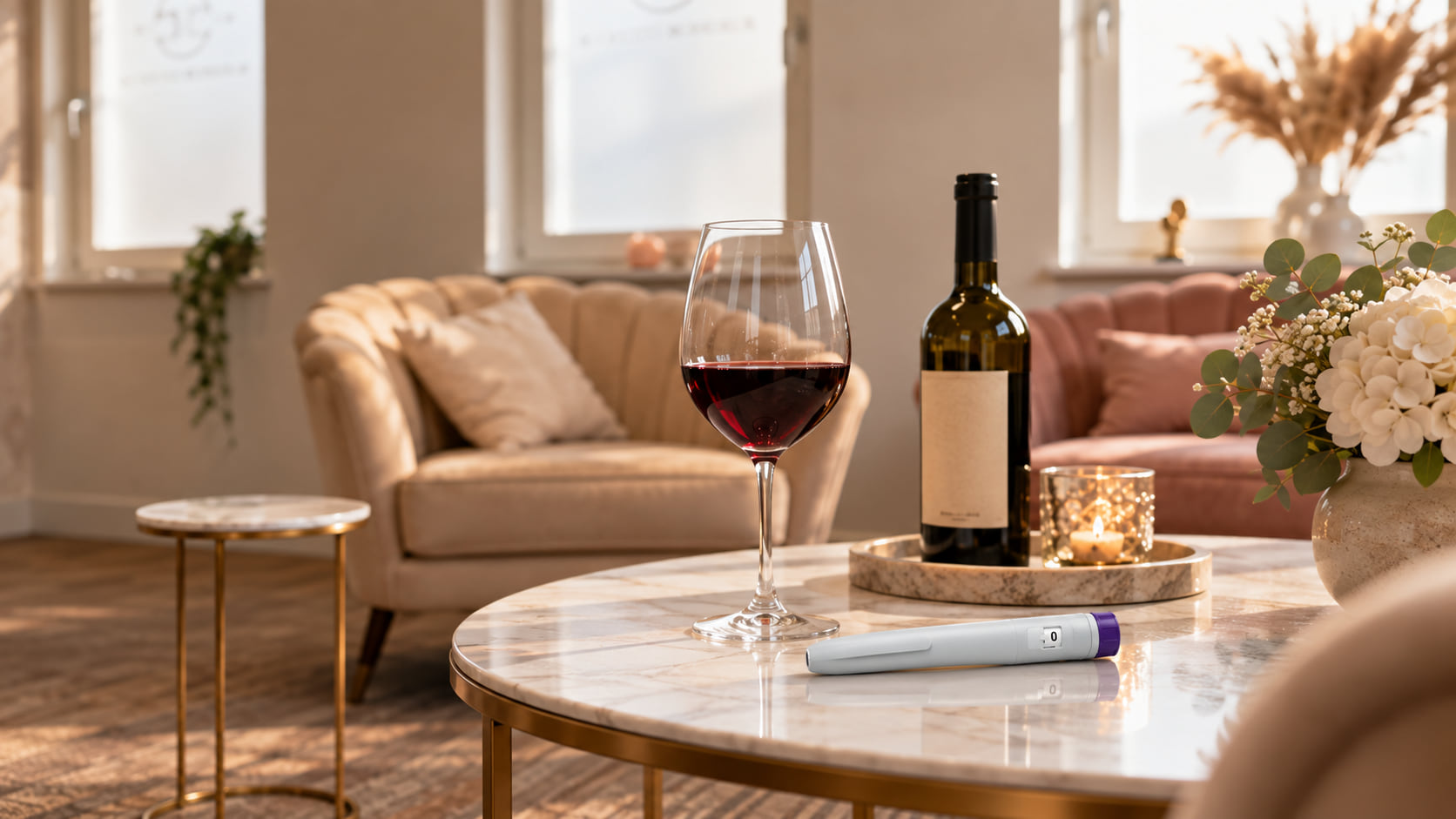
Can you drink alcohol while using Mounjaro?
Yes, in moderation. According to apotheek.nl, the patient information website of the Dutch pharmacists' organisation KNMP, it is better not to drink alcohol with tirzepatide: it can cause low blood sugar and your body recovers from it more slowly. It is not a prohibition, and the patient information leaflet mentions no interaction. If in doubt, consult your doctor.
For people using Mounjaro to lose weight, there is a second reason: alcohol provides calories without satiety, exactly what you are trying to limit with the medicine. And in the build-up weeks, when nausea is strongest, alcohol makes those symptoms worse.
Below you can read what the official position is, what alcohol does in combination with Mounjaro, which side effects get worse, whether the medicine puts a strain on your liver, what alcohol does to your results and how to handle a party, a holiday or a new dose. Read more about the Mounjaro golden dose. Read more about Mounjaro vs Saxenda.
What does alcohol do to the way Mounjaro works?
Alcohol does not make Mounjaro less effective, but the combination changes how your body reacts. Tirzepatide is a GLP-1 and GIP receptor agonist: it curbs the appetite, slows gastric emptying and lowers blood sugar. Alcohol acts on the same systems, but in the opposite direction. Read more about how to buy Mounjaro.
- Slower gastric emptying. Alcohol stays in your stomach for longer. You feel the effect more slowly and sometimes more strongly than you are used to, and the stomach becomes irritated sooner.
- Blood sugar. Tirzepatide lowers blood sugar; alcohol inhibits the production of glucose by the liver. If you drink without eating, your blood sugar can drop.
- Appetite and inhibitions. Tirzepatide dampens cravings; alcohol lowers your inhibitions and increases the desire for salty and fatty food.
What users also report: alcohol "hits harder" than it used to. That fits with the slower gastric emptying and the smaller volume you eat.
Side effects alcohol can intensify: nausea and blood sugar
Alcohol mainly intensifies the side effects that are already the most common with Mounjaro: nausea, vomiting, diarrhoea and a full feeling. These symptoms occur in more than 10 in 100 users, especially in the first weeks and after each dose increase. On top of that, alcohol can worsen dizziness, tiredness and dehydration.
Low blood sugar is rare with Mounjaro without other diabetes medication. The risk rises if you also use insulin or sulphonylureas, and alcohol makes that risk greater. Signs of low blood sugar are trembling, sweating, palpitations and sudden hunger; if that happens, eat something and stop drinking.
Two rare but serious risks deserve attention: inflammation of the pancreas and gallstones. Alcohol is itself a risk factor for pancreatitis. If you have severe, persistent abdominal pain, stop the medicine and call your doctor straight away. The full overview is in our article on Mounjaro side effects.
Does Mounjaro put a strain on the liver?
No, Mounjaro is not known as a medicine that is toxic to the liver. The Farmacotherapeutisch Kompas (the Dutch national medicines reference) of Zorginstituut Nederland (the Dutch National Health Care Institute) does not prescribe any dose adjustment for reduced liver function. Caution only applies in severe liver impairment, because there is too little data on it.
The combination with alcohol is therefore not a question of the medicine putting a double strain on the liver, but of the strain caused by the alcohol itself. Anyone with a liver condition should discuss alcohol use with their doctor in any case. Weight loss, incidentally, has a beneficial effect on fatty liver, a condition that often goes together with overweight.
Want to lose weight with a doctor who also answers questions like these? In a few minutes you will know whether medical weight loss could suit you; the doctor then assesses your application. Eligibility check →
Does alcohol affect your weight loss results?
Yes, in three ways: calories, appetite and recovery. According to the Voedingscentrum (the Netherlands Nutrition Centre), alcohol provides 7 kilocalories per gram; a 250 ml glass of beer contains about 88 kcal and a 100 ml glass of wine about 96 kcal. Two glasses in an evening equal a small meal, without making you feel full.
In addition, alcohol breaks through exactly the effect you use Mounjaro for: the dampened appetite. People who drink often eat more and make worse choices, that same evening and the day after. Alcohol also disrupts your sleep, and poor sleep raises the hunger hormones the next day.
The Voedingscentrum and the Gezondheidsraad (the Health Council of the Netherlands) advise not drinking alcohol; there is no safe amount. For people losing weight, that is also the most practical advice. A single glass at a party will not ruin your programme; drinking every day will.
Wanting less alcohol: what users notice and what research says
Many Mounjaro users report that they feel less like drinking alcohol, have had enough sooner and are quicker to leave a glass unfinished. It is one of the most frequently heard experiences, alongside reduced cravings for snacks. You can read more about it in our article on Mounjaro reviews. Read more about how fast Mounjaro works.
Research points in the same direction. A large cohort study in The BMJ among US veterans with type 2 diabetes found that people who started a GLP-1 receptor agonist had a lower risk of developing an alcohol or other substance use disorder than people on other diabetes medication. The explanation probably lies in the brain's reward system, where GLP-1 receptors are also found.
Two caveats. This is observational research in a specific group, and Mounjaro is not a treatment for alcohol addiction and is not licensed for it. Anyone with an alcohol problem should discuss it with their GP. What it does mean: if you notice that alcohol becomes less appealing, that is a known effect, not a coincidence.
In practice: how to handle a party, a holiday or a new dose
In practice, the advice depends on the stage of your treatment. The build-up weeks of the Mounjaro dosage schedule, and the week after each increase, are the phase with the most side effects. That is when you preferably leave alcohol alone. On a stable dose, a single glass is usually well tolerated.
| Moment | Risk | Advice |
|---|---|---|
| First 4 weeks (2.5 mg) | Nausea and stomach complaints are already high | No alcohol |
| Week after a dose increase | Side effects temporarily return | No alcohol, or at most 1 glass with a meal |
| Stable dose, party or dinner | Low blood sugar, eating more | Maximum 1 glass, always with food, water alongside |
| Holiday | Daily drinking, heat, irregular meals | Build in alcohol-free days, keep the pen cool, plenty of water |
| The day after drinking | Nausea, tiredness, dip in blood sugar | Light breakfast with protein, drink plenty, keep the injection on its usual day |
When is it better to avoid alcohol altogether?
- During the build-up phase and the week after each dose increase.
- If you also use insulin or sulphonylureas, because of the risk of low blood sugar.
- If you have a liver or pancreatic condition, or after a previous inflammation of the pancreas.
- If you have persistent vomiting or diarrhoea, because of dehydration.
- If you notice that alcohol disrupts your eating pattern.
Tell your doctor that you drink now and then; the doctor can then take it into account in your support. With us, you discuss this with your own doctor during the medical weight loss with injections programme.
Want support from your own doctor at every step? The doctor assesses whether medical weight loss is right for you and can be reached if you have side effects. Medical weight loss with injections →
Frequently asked questions about eating and drinking on Mounjaro
Can you drink alcohol while using Mounjaro?
It is not forbidden, but apotheek.nl advises preferably not drinking alcohol, because it can cause low blood sugar. Alcohol also increases the chance of nausea and works against weight loss. In the build-up weeks you preferably leave alcohol alone; later, a single glass with food is usually well tolerated.
Is it good to drink alcohol while losing weight?
No. Alcohol provides 7 kilocalories per gram without satiety, lowers your inhibitions around food and disrupts your sleep. The Voedingscentrum and the Gezondheidsraad advise no alcohol. A single glass at a party need not disrupt your programme; drinking regularly slows your results.
Which alcohol can you drink when losing weight?
If you drink, choose a dry wine or a small glass of beer, without sugary mixers, liqueurs or cocktails, and have it with a meal with water alongside. Each glass provides about 90 to 100 kilocalories.
What should you not eat on Mounjaro?
There are no forbidden foods, but fatty, fried, very sweet and large meals increase the chance of nausea and a full feeling. Eat smaller portions with enough protein and fibre and drink enough. A practical plan is in our article on the Mounjaro diet.
Can you drink alcohol if you use Ozempic or Saxenda?
The same principle applies to Ozempic and Saxenda: no prohibition, but caution because of nausea, blood sugar and calories. The details per medicine are in our articles on Ozempic and alcohol and Saxenda and alcohol.
Does Mounjaro help with alcohol addiction?
Mounjaro is not licensed for that and is not a treatment for alcohol addiction. Research does show that users of GLP-1 medication have a lower risk of developing a substance use disorder, and many users report wanting alcohol less. If you have an alcohol problem, your GP is the right person to see.
<!-- klant:eind -->Responsible for this information: Qlinic B.V., Markenhaven 25A, Amersfoort. Published: 8 September 2026. This article is general information and does not replace personal medical advice.
About the author
Nazanin Ahmadi Mozafari
Doctor · BIG 59925559301
Guides you from intake to follow-up and knows your file, no changing faces.
More about Nazanin Ahmadi Mozafari
Further reading
Mounjaro · 10 min
Mounjaro diet plan: what to eat and what to avoid, with a daily menu and recipes
By Nazanin Ahmadi Mozafari, doctor
Mounjaro · 9 min
Tirzepatide: the active substance in Mounjaro
By Nazanin Ahmadi Mozafari, doctor
Mounjaro · 15 min
Mounjaro side effects: what to expect (and what you can do)
By Nazanin Ahmadi Mozafari, doctor