Ozempic9 min read5 September 2026
Ozempic eyes: what is known about blurred vision, NAION and blindness?
You read something about Ozempic and blindness, or you have noticed that your vision has become a little blurrier since you started. Then you want to know exactly what is going on, how big the risk is and when to raise the alarm.
 By Nagita Grover-Khatri
 Medically reviewed by Nazanin Ahmadi Mozafari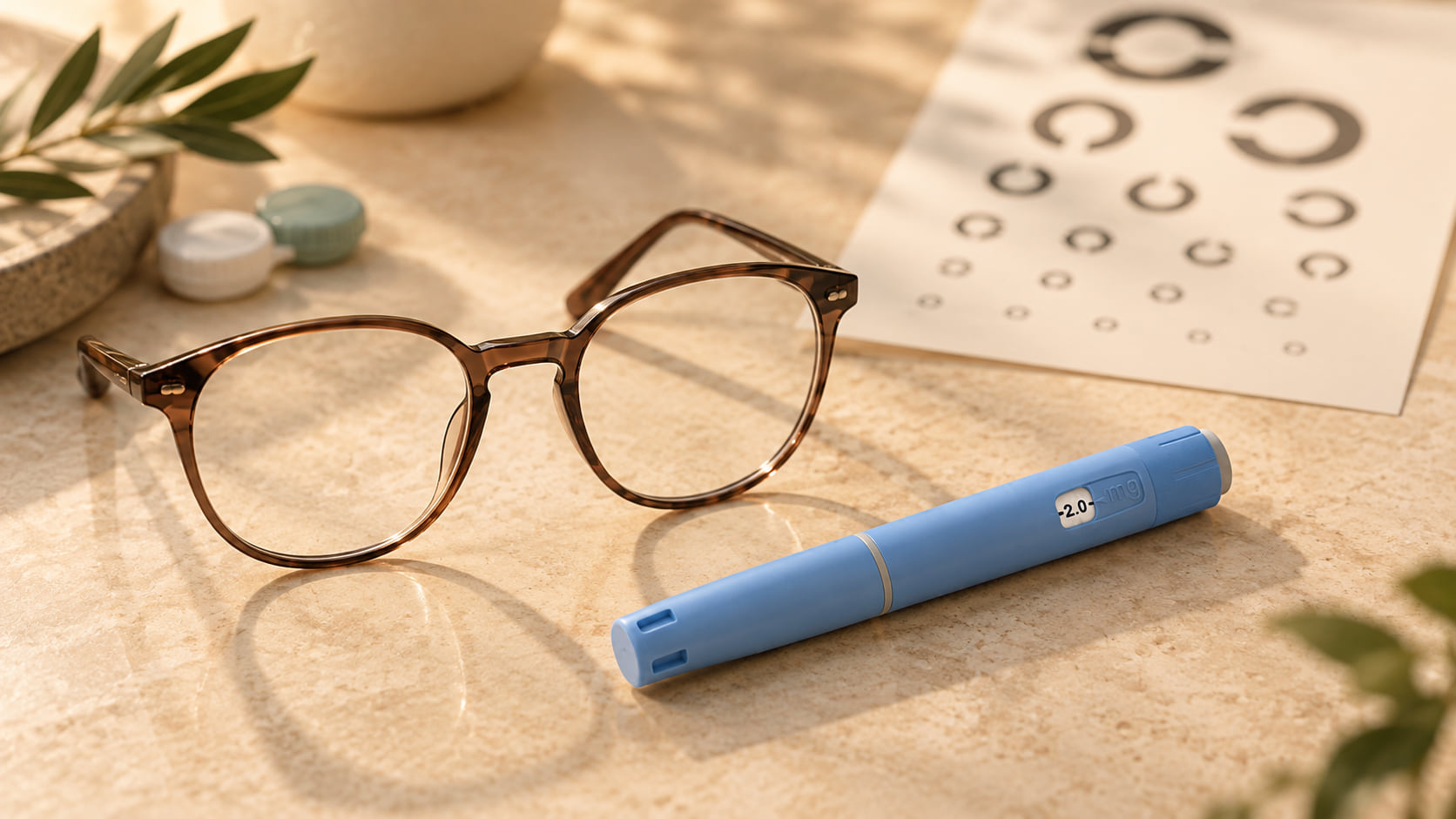
Can Ozempic make you go blind? The short answer
Going blind from Ozempic is very rare, but not impossible: the eye condition NAION can cause sudden, permanent loss of vision in one eye and has been recognised as a very rare side effect of semaglutide since 2025. According to the College ter Beoordeling van Geneesmiddelen (CBG, the Dutch Medicines Evaluation Board), the side effect may occur in 1 in 10,000 people who use the medicine.
If you notice that you suddenly see worse, or your vision deteriorates quickly, contact your doctor straight away. If it turns out to be NAION, you stop semaglutide. Read more about how fast Ozempic works.
Below you can read what NAION is and what has been studied, how to recognise the symptoms, why your vision can become temporarily blurred, who needs to take extra care, what is known about dry eyes and recovery after stopping, and how to report a side effect. Read more about the Ozempic diet.
What is NAION and what exactly has been studied?
NAION stands for non-arteritic anterior ischaemic optic neuropathy: a condition in which the optic nerve temporarily receives too little blood and is damaged as a result. It usually causes sudden, painless loss of vision in one eye, often noticed on waking. The lost vision usually does not fully recover.
It drew attention in 2024 after a study in JAMA Ophthalmology from an eye hospital in Boston. In that study, NAION occurred more often in patients given semaglutide than in comparable patients on other medication, both in type 2 diabetes and in overweight. The study was small and observational and could not prove cause, but it prompted a European assessment.
The EMA's pharmacovigilance committee PRAC then assessed all available data: clinical trials, reports after marketing authorisation and the scientific literature. Its conclusion in June 2025: NAION is a very rare side effect of semaglutide and is being added to the patient information leaflet of Ozempic, Rybelsus and Wegovy. The product information for Ozempic now states that large epidemiological studies in type 2 diabetes point to a roughly twofold relative risk, which corresponds to about 1 extra case per 10,000 patient-years of treatment.
Important: this concerns semaglutide as a substance, not one brand. Ozempic, Wegovy and Rybelsus all contain semaglutide.
| Eye problem | How common | Likely cause | What you do |
|---|---|---|---|
| Sudden loss of vision in one eye | very rare (up to 1 in 10,000) | NAION | call your doctor straight away; stop if diagnosed |
| Temporarily blurred vision in the first weeks | fairly common | rapidly falling blood sugar changes the lens of the eye | wait and see, discuss at your check-up; do not stop on your own |
| Worsening of existing diabetic eye damage | known risk in diabetes with insulin | rapid improvement in blood sugar | eye check before and during treatment |
| Dry or tired eyes | not established as a side effect | dehydration, drinking less | drink more; if it persists, discuss it |
How do you recognise the symptoms and what do you do?
The signs of NAION are sudden loss of vision or a dark patch in the field of vision of one eye, usually painless and often noticed on waking. Sometimes part of the image, for example the lower half, looks blurred or grey.
With these symptoms, call your doctor or the out-of-hours GP service (huisartsenpost) straight away. An ophthalmologist then assesses whether it is NAION. If the diagnosis is confirmed, you stop semaglutide; that is the official advice of the EMA and CBG. Do not stop on your own initiative for mild symptoms: discuss them first, because most eye problems have a different cause.
With a medical weight loss programme with injections, you have your own doctor whom you can reach straight away with signs like these, and who maps out your risk factors at the start.
Blurred vision from Ozempic: temporary or not?
Blurred vision in the first weeks of Ozempic is usually temporary and is caused by rapidly falling blood sugar. When your blood sugar changes, the fluid content of the lens of your eye changes too, and with it the strength of your eyes. This effect is known from all medicines that improve blood sugar quickly.
The lens usually adjusts within a few weeks and your vision becomes sharp again. Do not have new glasses fitted during that period: the strength is still changing. If the blurred vision gets worse, lasts longer than a few weeks or appears suddenly in one eye, call your doctor.
Dehydration can also cause blurred or tired vision. If you drink little because of nausea or reduced appetite, you sometimes notice it in your eyes. Drinking enough water helps in that case.
Ozempic and diabetic retinopathy: who needs to take extra care?
If you have type 2 diabetes and existing eye damage (diabetic retinopathy), Ozempic calls for extra monitoring. The product information states that in this group, especially in combination with insulin, an increased risk of complications of retinopathy has been seen. The likely explanation is the rapid improvement in blood sugar, which can temporarily worsen existing eye damage.
That is why diabetes calls for an eye check before starting and regular checks during treatment. Semaglutide 2 mg is not recommended in retinopathy that is unstable or not under control.
If you use Ozempic to lose weight and do not have diabetes, this risk does not apply in the same way; your blood sugar is already normal. How diabetes medication and weight loss go together is covered in the article on diabetes medication for weight loss.
Want to lose weight with medication, but with a doctor who knows your risks? The doctor assesses whether medical weight loss is right for you and takes your eye and diabetes history into account. Read more about medical weight loss with injections →
Dry eyes and other eye problems: what is known?
Dry eyes are not listed as a side effect in the Ozempic patient information leaflet, and there is no research showing a direct link. Even so, some users report dry or stinging eyes. The most likely explanation is dehydration from drinking less, nausea or diarrhoea during the dose-escalation phase.
What the leaflet does list: complications of diabetic retinopathy (in diabetes) and NAION (very rare). Other eye problems, such as floaters or flashes of light, usually have a different cause but always deserve assessment by a doctor.
The full overview of side effects, from nausea to the rare serious ones, is in the article on Ozempic side effects.
Does your vision recover after stopping Ozempic?
That depends on the cause. Temporarily blurred vision from changing blood sugar almost always recovers, often during use and otherwise after stopping. NAION is different: the damage to the optic nerve is usually permanent, and stopping serves to prevent further damage, not to restore the vision that was lost.
There is no established period after the start in which NAION can develop. That is why the advice stays the same throughout treatment: suddenly seeing worse is always a reason to call straight away. How to stop responsibly and what then happens to your weight is covered in the article on stopping Ozempic.
Reporting side effects to Lareb
If you notice a side effect, you can report it yourself to Bijwerkingencentrum Lareb, the Dutch centre for reporting side effects of medicines. Up to June 2025, Lareb had received four reports of NAION with the use of semaglutide, and it advises users to watch out for deteriorating vision.
You can report online, even if you are not sure whether the symptom is caused by the medicine. These reports matter especially for rare side effects: that is also how NAION came to light. Your doctor or pharmacist can also make the report for you.
Tried everything and wondering whether a medical programme is right for you? A few questions show you where you stand, and the doctor then assesses your situation. Take the eligibility check →
Frequently asked questions about Ozempic and your eyes
What does Ozempic do to your eyes?
For most users, nothing. In the first weeks, vision can be temporarily blurred due to falling blood sugar. In diabetes with existing eye damage, that damage can temporarily get worse. Very rarely (up to 1 in 10,000), NAION develops, a condition of the optic nerve with sudden loss of vision.
What are the worst side effects of Ozempic?
The rare serious side effects are inflammation of the pancreas, gallstones, severe dehydration with kidney problems, severe allergic reactions and NAION. They are uncommon, but call for immediate contact with a doctor if you have severe abdominal pain, persistent vomiting or suddenly worse vision.
What are the long-term risks of Ozempic?
Semaglutide has been in use since 2018 and has been followed in large studies for up to several years. The known longer-term risks are the rare side effects above and weight gain after stopping. New signals, such as NAION, are continuously assessed by the EMA, CBG and Lareb.
What are the features of an Ozempic face?
An "Ozempic face" is not a side effect of the medicine but the result of rapid weight loss: less fat in the face makes the skin looser and the features sharper. What you can do about it is covered in the article on Ozempic face.
Does the NAION risk also apply to Wegovy and Rybelsus?
Yes. The PRAC conclusion applies to all medicines containing semaglutide: Ozempic, Wegovy and Rybelsus. The leaflets of all three have been updated. The side effects of Wegovy are covered in the article on Wegovy side effects.
How do you prevent eye problems while on Ozempic?
If you have diabetes, have your eyes checked before you start, drink enough, mention blurred vision at your check-up and call straight away if you suddenly lose vision. No specific way to prevent NAION is known; acting quickly when symptoms appear is the most important thing.
<!-- klant:eind -->Responsible for this information: Qlinic B.V., Markenhaven 25A, Amersfoort. Published: 5 September 2026. This article is general information and does not replace personal medical advice.
About the author
Nagita Grover-Khatri
Doctor · BIG 39912467601
Focuses on medical programmes for overweight, with attention to the person behind the numbers.
More about Nagita Grover-Khatri
Further reading

Ozempic · 10 min
Stopping Ozempic: tapering off and what happens next
By Nazanin Ahmadi Mozafari, doctor
Ozempic · 9 min
How fast does Ozempic work? What you notice week by week
By Nazanin Ahmadi Mozafari, doctor
Weight loss medication · 12 min
Diabetes medication for weight loss: how does it work?
By Nazanin Ahmadi Mozafari, doctor