
Weight loss medication12 min read15 September 2026
Diabetes medication for weight loss: how does it work?
You read everywhere about people losing weight with a medicine that is actually intended for diabetes. You may be wondering how that's possible, whether it's safe and whether it might be something for you, especially if losing weight on your own keeps failing. The short answer: some diabetes medicines suppress your feeling of hunger, which makes you lose weight, and there are now versions that have been approved specifically for that purpose. Always on prescription and under the supervision of a doctor. Here you'll read how these medicines work, how much weight you lose with them on average, which side effects you can expect and what the safe, legal route is.
 By Nagita Grover-Khatri
 Medically reviewed by Nazanin Ahmadi Mozafari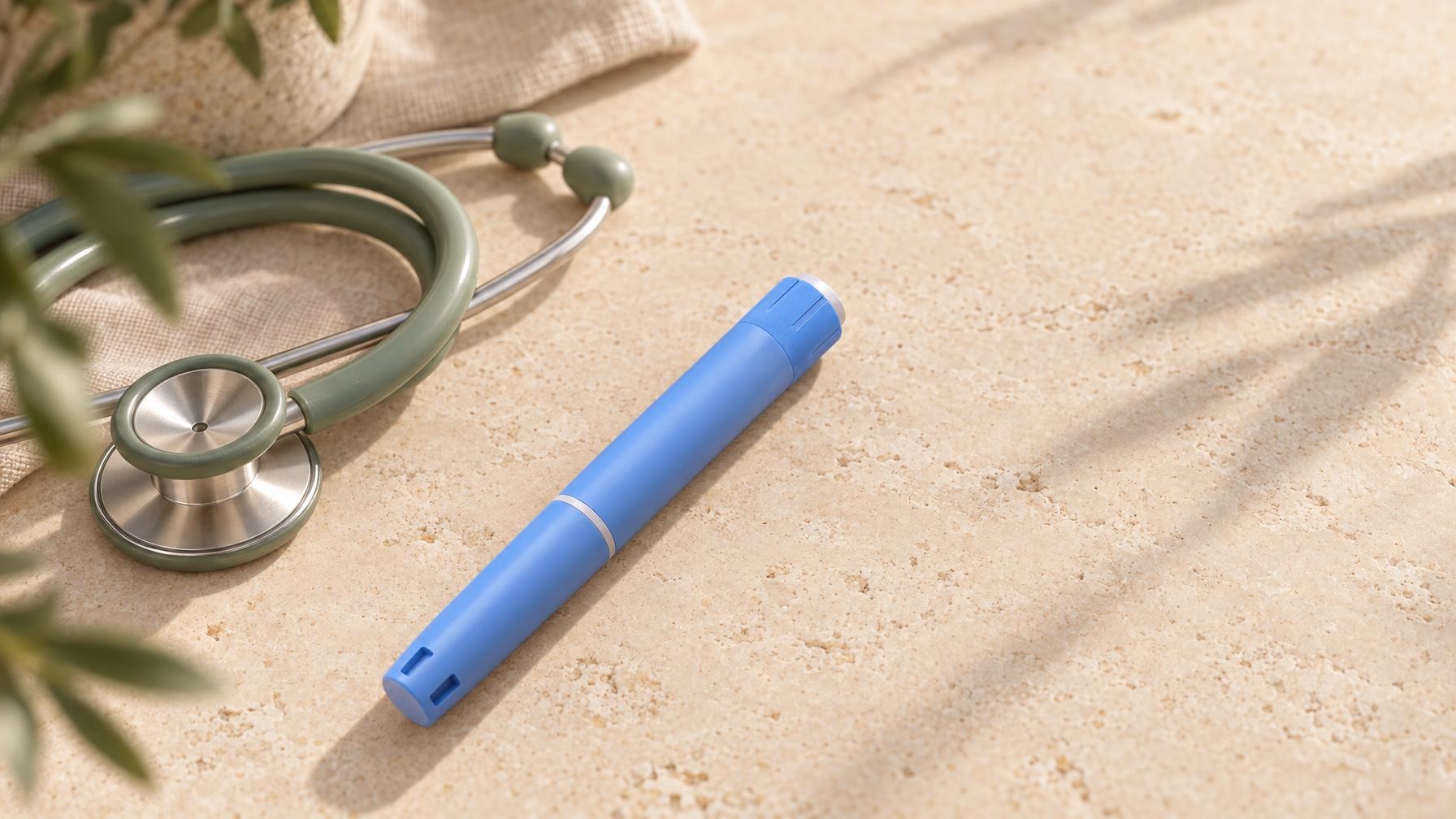
Why do you lose weight on diabetes medication?
Some diabetes medicines, such as Ozempic, mimic the gut hormone GLP-1. They not only lower your blood sugar, but also slow your gastric emptying and suppress your feeling of hunger. As a result you eat less without much effort and lose weight. This effect is so strong that versions have now been approved specifically for weight loss.
GLP-1 is a hormone that your gut produces as soon as you eat. It sends your brain the signal "full" and makes your stomach pass food on more slowly. Medicines that mimic this hormone are called GLP-1 agonists. They were developed to regulate blood sugar in type 2 diabetes, but something else stood out in the studies: patients also lost a considerable amount of weight.
The more stable blood sugar itself also helps. Big peaks and dips in your blood sugar fuel cravings: after every dip your body wants new energy quickly, preferably in the form of fast sugars. When that pattern levels out, many of those snacking moments disappear by themselves. Many users describe it as calm in their head: the constant thinking about food goes quiet.
This doesn't apply to all diabetes medication. The weight loss is specific to the GLP-1 medicines; with other diabetes medicines, such as insulin, you may actually gain weight. So the question is not whether diabetes medication makes you lose weight, but which medicines do.
Which medicines make you lose weight?
You mainly see weight loss with three active substances from the GLP-1 family: semaglutide, liraglutide and tirzepatide. Each of these substances exists as a diabetes medicine, and for each there is a route that is officially approved for weight loss in people with overweight.
| Active substance | Known as a diabetes medicine | Approved for weight loss | Average weight loss in research |
|---|---|---|---|
| Semaglutide | Ozempic (injection), Rybelsus (tablet) | Wegovy (higher dose) | approx. 15% in 68 weeks |
| Liraglutide | Victoza | Saxenda (daily injection) | lower than semaglutide |
| Tirzepatide | Mounjaro | Mounjaro (also registered for overweight) | approx. 21% in 72 weeks (highest dose) |
Semaglutide is the best-known substance. As Ozempic it is a diabetes medicine; Wegovy contains the same substance at a higher dose and is approved for weight loss. We supervise semaglutide treatments through medical weight loss with injections.
Liraglutide works in the same way, but you inject it daily instead of weekly. As Saxenda, it has been approved for weight loss for longer.
Tirzepatide is the newest substance and acts on two hormones at once: GLP-1 and GIP. In Europe, Mounjaro is registered for type 2 diabetes and for weight management in people with overweight. You can read more about this under medical weight loss with injections.
Most of these medicines are injections you give yourself with a thin pen, weekly or daily. Only Rybelsus is a tablet, and for now it is registered exclusively for type 2 diabetes. So be alert to "slimming pills" that promise the effect of these medicines: supplements and drops sold without a prescription don't contain these active substances.
That leaves the question: are you actually allowed to use such a medicine if you don't have diabetes?
Can I lose weight with medication for diabetes?
Yes, you can, but only on a doctor's prescription and preferably with a medicine that is approved for weight loss. A diabetes medicine such as Ozempic is registered for type 2 diabetes, not for weight loss. That distinction is more important than it sounds.
When losing weight with Ozempic became a worldwide hype, a shortage arose and people with diabetes were caught short. The College ter Beoordeling van Geneesmiddelen (the Medicines Evaluation Board, the Dutch medicines regulator) therefore called on doctors to be cautious about prescribing it outside diabetes, and calls use without medical supervision "very unwise". This is partly why there are now separate medicines for weight loss, so that the diabetes supply is protected.
Never buy these medicines online without a prescription. Providers without a prescription operate outside the law and regularly sell counterfeits: pens with the wrong dose or without any active substance. The legal route is the only safe one: a doctor assesses whether medication is suitable and safe for you, writes a prescription if you're suitable, and a registered Dutch pharmacy supplies the medication.
Want to lose weight with medication, but safely and legally? At Qlinic, our regular BIG-registered doctor (the BIG register is the Dutch register of healthcare professionals) personally assesses whether medical weight loss suits you, with home delivery through registered Dutch pharmacies. Take the eligibility check →
How many kilos do you lose and what does it do to your body?
In large studies, participants lose an average of 15% to 21% of their body weight. In the STEP 1 trial, published in The New England Journal of Medicine, adults with overweight or obesity taking weekly semaglutide 2.4 mg lost an average of 14.9% in 68 weeks, compared with 2.4% on placebo. With tirzepatide, in the SURMOUNT-1 trial, this rose to an average of 20.9% at the highest dose after 72 weeks.
Two caveats about these figures. They come from research with the higher doses for weight loss, not with the lower diabetes doses. And in both studies, participants also received support with diet and exercise: the medication didn't do the work on its own. How much weight you lose also varies from person to person.
What do you notice in your body? Your blood sugar becomes more stable, with fewer peaks and dips. Your stomach passes food on more slowly, so you feel full sooner and for longer. And your brain receives fewer hunger signals, so a normal portion suddenly feels like enough. That is exactly what makes eating less sustainable, even if diets never worked for you before.
The pace varies from person to person, but the pattern is recognisable: the dose is built up in steps, the effect grows in the first months and then gradually levels off. That levelling off is normal too. Your body is looking for a new balance, and that is exactly when the supervision counts: together with the doctor you decide whether to continue, adjust your dose or start tapering off.
To be clear: it is not a miracle cure. When you lose weight quickly, you lose muscle mass as well as fat, so enough protein and exercise remain necessary. And if you stop the medication without your habits having changed, the feeling of hunger returns and often some of the weight too. See it as an aid that makes a healthy lifestyle achievable, not as a replacement for it.
Which side effects can you expect?
The most common side effects are gastrointestinal complaints: nausea, diarrhoea, constipation and a full or bloated feeling. They mainly occur in the first weeks and after a dose increase, and usually decrease after that. Serious side effects, such as pancreatitis or gallstones, are rare.
The complaints are directly linked to how the medicine works: your stomach and gut have to get used to the new pace. A calm dosing schedule and smaller portions make the biggest difference. What else helps in practice:
- Eat small portions and stop at the first sign of feeling full
- Avoid fatty and heavy food; it now stays in your stomach for extra long
- Drink enough water, especially with diarrhoea or constipation
- Call your doctor if you have severe or persistent abdominal pain, persistent vomiting or if complaints don't decrease
You'll find a complete overview per medicine, including what you can do yourself and when to call a doctor, in our article on GLP-1 side effects.
It is precisely because of these side effects that supervision is not a formality. At Qlinic, the doctor draws up your dosing schedule and makes adjustments if you have complaints. If you run into problems in between, you consult the doctor about adjusting the dose, pausing or stopping.
Can I get it through my GP and what does it cost?
You only get Ozempic through your GP (huisarts) if you have type 2 diabetes. GPs only prescribe medicines for weight loss in specific situations. According to Thuisarts.nl (the Dutch GP association's patient website), this only comes into consideration with a BMI of 40 or higher, or 35 or higher in combination with a condition such as osteoarthritis or heart problems, and after you have followed a recognised lifestyle programme for at least a year. What's more, not every GP prescribes these medicines.
Only within that strict route is the medication generally reimbursed from basic health insurance (basisverzekering). The lifestyle programme from those conditions is the so-called combined lifestyle intervention (gecombineerde leefstijlinterventie, GLI), a recognised two-year programme around diet, exercise and behaviour. You can read in which cases weight loss medication is covered by insurance in our article on the subject.
If you fall outside those criteria, you can go to a specialised clinic and pay for the treatment yourself. That is the situation of most people we speak to: too heavy to manage on their own, but not heavy enough for the GP route.
As an indication, our treatment prices, including prescription and medical supervision:
| Treatment at Qlinic | Price |
|---|---|
| Injections with semaglutide (Ozempic) | €250 per month or €699 per 3 months |
| Injections with tirzepatide (Mounjaro) | €350 per month or €999 per 3 months |
| Injections with liraglutide (Saxenda) | €850 per month |
| One-off supervision costs | €400 |
Whether medical weight loss suits you is not a question of price but a medical question. The doctor assesses that beforehand through the eligibility check.
Medical weight loss under the supervision of a doctor
If you want to lose weight with this medication, medical supervision is not a luxury but a requirement. Especially when building up the dose, with side effects and with the question of when you can taper off, a doctor makes the difference. At Qlinic it works like this:
- Consultation and intake: our regular BIG-registered doctor personally assesses whether medical weight loss is suitable and safe for you.
- Prescription and home delivery: if you're suitable, you receive a prescription and the medication is delivered to your home through registered Dutch pharmacies.
- Losing weight with regular follow-up: every 4 weeks you speak to the same doctor. You usually notice the first effect after about 4 weeks, mainly because the feeling of hunger decreases.
We are deliberately small-scale: you have one regular doctor who knows you and your file, no changing faces. We have now supervised around 50 people, with a 5.0 on Google from more than 20 reviews.
Many of the people we supervise recognise themselves in the same story: years of dieting, exercise, perhaps a personal trainer, and still the weight keeps coming back. For women going through menopause, there is also a hormonal factor that makes losing weight extra difficult. That's exactly when it isn't a matter of trying harder, but of an approach that tackles the underlying feeling of hunger.
The medication mainly takes away the feeling of hunger, but not every cause of weight gain. You can read why losing weight sometimes doesn't work even with the best will in the world in our article on why you're not losing weight. That's why, during the follow-ups, the doctor looks beyond the scales: at your diet, your energy and what you need to keep it up.
Tried everything and still not losing weight? Our regular BIG-registered doctor personally looks at whether medical weight loss suits you, with a regular follow-up every 4 weeks. Take the eligibility check →
Frequently asked questions about weight loss and diabetes medication
Can I lose weight with medication for diabetes?
Yes. GLP-1 medicines, originally developed for type 2 diabetes, suppress your feeling of hunger and so support weight loss. This is only possible on prescription and under the supervision of a doctor, preferably with a version that is officially approved for weight loss.
How many kilos do you lose on Ozempic?
That varies per person and per dose. In research with semaglutide at the higher dose for weight loss (2.4 mg), participants lost an average of 14.9% of their body weight in 68 weeks. Ozempic has a lower dose, so don't count on a fixed number of kilos; your doctor will help you set realistic expectations.
What does Ozempic do to your body?
Ozempic mimics the gut hormone GLP-1: it lowers your blood sugar, slows your gastric emptying and suppresses your feeling of hunger. As a result you eat less and lose weight. At the start you may get gastrointestinal complaints, such as nausea; these usually decrease once your body has got used to it.
Can I get Ozempic through my GP?
Only if you have type 2 diabetes. GPs don't prescribe Ozempic for weight loss, and only prescribe weight loss medication under strict criteria, such as a high BMI plus a completed lifestyle programme. Outside that route, a doctor at a specialised clinic can assess whether medication suits you.
Is weight loss medication reimbursed?
Usually not. Reimbursement from basic health insurance only applies within the strict GP route, with conditions including a high BMI and a recognised lifestyle programme. If you choose a treatment at a specialised clinic, you pay the costs yourself.
Is losing weight with a diabetes medicine safe?
Under the supervision of a doctor it is safe for most people: the doctor assesses your health beforehand, builds up the dose calmly and keeps an eye on side effects. Buying online without a prescription is dangerous and illegal; counterfeits with the wrong doses turn up regularly.
Responsible for this information: Qlinic B.V., Markenhaven 25A, Amersfoort. Published: 15 September 2026. This article is general information and does not replace personal medical advice.
About the author
Nagita Grover-Khatri
Doctor · BIG 39912467601
Focuses on medical programmes for overweight, with attention to the person behind the numbers.
More about Nagita Grover-Khatri
Further reading

Weight loss medication · 8 min
GLP-1 side effects: a clear overview
By Nazanin Ahmadi Mozafari, doctor
Weight loss medication · 9 min
Is weight loss medication covered by insurance? How it works in 2026
By Nazanin Ahmadi Mozafari, doctor

Knowledge · 12 min
Why am I not losing weight? 8 causes and what does work
By Nazanin Ahmadi Mozafari, doctor