
Menopause11 min read7 September 2026
Menopause diet and nutrition: what does work?
You eat roughly the same as ten years ago, you may even move more, and yet the scales are creeping up. Especially around your belly. A special menopause diet doesn't exist, but in this phase your body does ask for a different emphasis: more protein, more fibre and a tighter grip on your energy balance. Below you'll read what changes hormonally, which foods do help, what you're better off limiting, what a weekly menu looks like and where the line lies between adjusting things yourself and medical supervision.
 By Nagita Grover-Khatri
 Medically reviewed by Nazanin Ahmadi Mozafari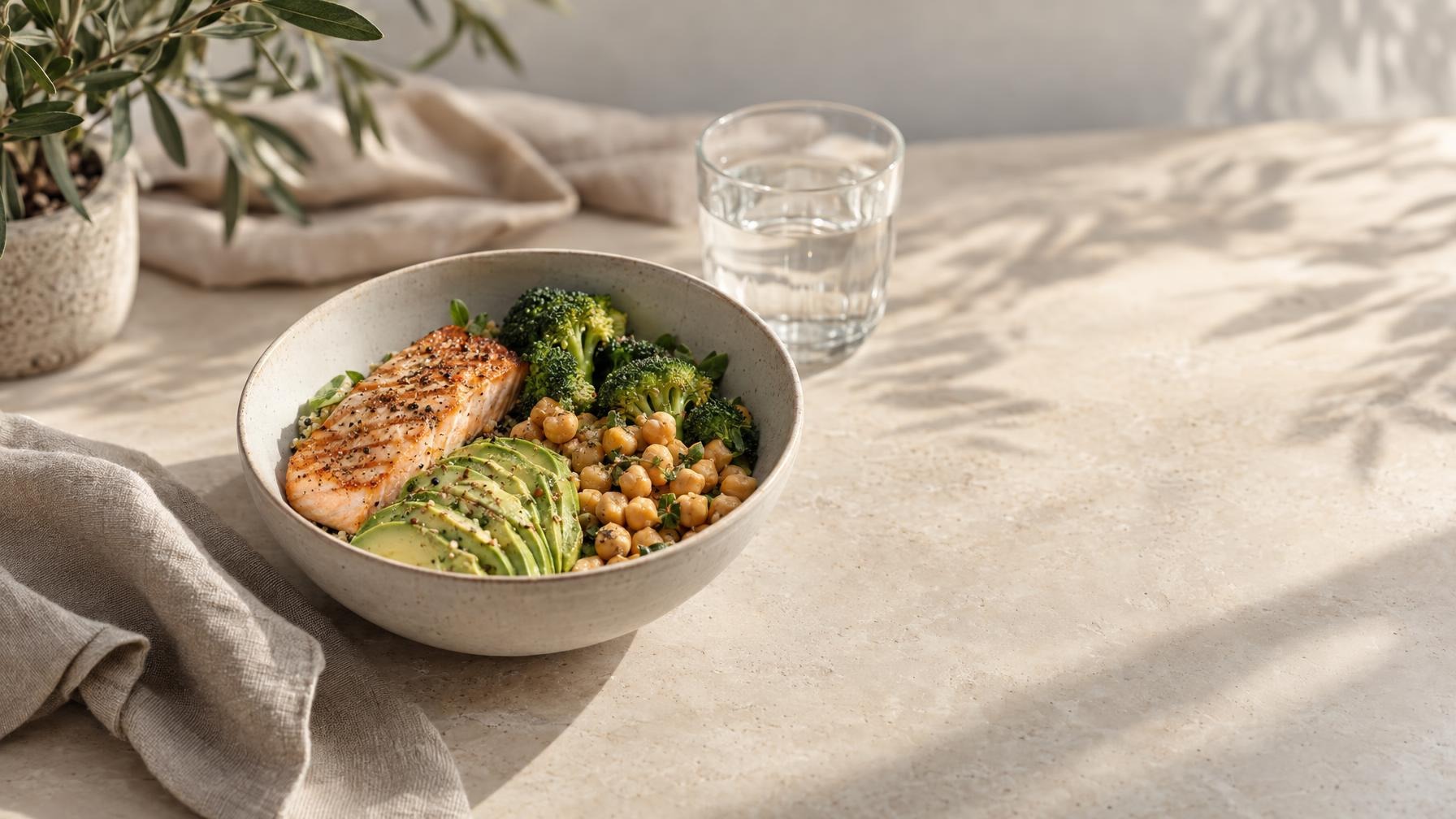
Which diet works best during menopause?
There is no diet developed specifically for menopause. What holds up best in research is a Mediterranean eating pattern: lots of vegetables, fruit, pulses, oily fish and olive oil, supplemented with enough protein. It's not the name of the diet that determines your result, but whether you can keep it up for months.
Do you notice that weight loss during menopause goes much more slowly than it used to? Then this article was written for you.
Why do you gain weight during menopause?
During menopause you mainly gain weight differently, not necessarily much more. Your weight rises at roughly the same pace as before, but the ratio between fat and muscle shifts.
That's down to your hormones. When your oestrogen falls, fat moves from your hips and legs to your belly. At the same time your muscle mass gradually decreases, and muscle is precisely the tissue that uses energy at rest. Your metabolism therefore drops a notch, while your eating pattern stayed the same.
In the large American SWAN study among 1,246 women, fat mass grew by about 0.25 kilos per year before menopause. During menopause that rate almost doubles to around 0.45 kilos per year, while fat-free mass actually starts to fall. About two years after your last period, that acceleration levels off again.
So this is not a matter of having less willpower than before. It is a measurable change in your body composition. You can read more about it in our article on menopause weight gain.
What really helps with weight loss during menopause?
A small energy deficit that you can keep up, combined with enough protein and strength training. Those three together do more than any diet name.
In a randomised study among 144 postmenopausal women with belly fat, they lost an average of 7.6 kilos in 16 weeks, their waist became 7.4 centimetres smaller and their belly fat decreased by almost a quarter. The striking thing: the Mediterranean version and the Central European version did equally well. What did make a difference was how well the participants stuck to the plan. Those who stuck to it better lost about 3 kilos more.
The four pillars that deliver the most during menopause:
- Energy balance. A deficit of 300 to 500 kilocalories per day is enough. Anything stricter mainly leads to muscle loss and a yo-yo effect.
- Protein with every meal. Think of 20 to 30 grams per meal from dairy, eggs, pulses, fish, chicken or tofu. Protein keeps you full for longer and protects your muscle mass.
- Strength training, twice a week. This is the only stimulus that really brings muscle tissue back. What that means in concrete terms you can read in strength training for women during menopause.
- Sleep and stress. Sleeping badly because of hot flushes increases your hunger the next day. In this phase, sleep is not a luxury but part of your approach.
Menopause diet: what do you eat?
Fill your plate with food that fills you up, supports your bones and keeps your blood sugar stable. In concrete terms, that means five points of emphasis.
- Protein as the basis of every meal. Quark or eggs at breakfast, pulses or fish at lunch, and a portion of 100 to 150 grams with your evening meal.
- Vegetables and fruit, a good 250 grams of vegetables and 2 pieces of fruit per day. The fibre fills your stomach without many calories.
- Wholegrain instead of white. Wholemeal bread, brown rice and oats give a slower rise in blood sugar than their white equivalents.
- Calcium and vitamin D. After menopause you lose bone mass faster. Three to four portions of dairy or a fortified alternative per day help with that.
- Unsaturated fat. Olive oil, nuts, avocado and oily fish such as salmon, herring or mackerel, twice a week.
Phytoestrogens from soya, linseed and pulses are often mentioned in connection with menopausal symptoms. They are safe as part of your diet, but don't expect weight loss from them. The effect on hot flushes varies greatly from person to person.
What should you avoid eating during menopause?
There is no food you absolutely have to cut out during menopause. There are, however, four categories that make things unnecessarily hard for you.
- Alcohol. Provides a lot of calories without filling you up, disrupts your sleep and can trigger hot flushes.
- Sugary drinks and snacks. They cause a rapid blood sugar spike and, shortly afterwards, hunger again.
- Highly processed products. Often high in salt, sugar and saturated fat, and rarely filling.
- Crash diets and meal replacements for the long term. Below 1,200 kilocalories per day you lose muscle mass as well as fat, which is exactly what you want to keep in this phase.
Caffeine and spicy food appear on many lists, but the evidence for this is weak and varies from person to person. Do you notice that coffee after four o'clock ruins your night's sleep, or that spicy food triggers your hot flushes? Then adjust it. If not, there's nothing you need to give up.
Sample weekly menu for menopause
This is what a week with enough protein, fibre and calcium looks like in practice. No special products, no complicated recipes.
| Day | Breakfast | Lunch | Evening meal | Snack |
|---|---|---|---|---|
| Monday | Oats with low-fat quark and berries | Wholemeal bread with hummus, egg and tomato | Salmon fillet, brown rice, broccoli | Handful of unsalted nuts |
| Tuesday | Wholemeal sandwich with egg and cucumber | Lentil soup with wholemeal bread | Chicken breast, sweet potato, green beans | Greek yoghurt with cinnamon |
| Wednesday | Greek yoghurt with nuts and apple | Salad with chickpeas, feta and olive oil | Stir-fry with tofu, pepper and wholewheat noodles | Pear |
| Thursday | Oats with linseed and banana | Wholemeal wrap with tuna and lettuce | Lean beef meatballs, quinoa, spinach | Quark with forest fruits |
| Friday | Wholemeal sandwich with low-fat cheese | Omelette with mushrooms and wholemeal bread | Mackerel, jacket potatoes, endive | Handful of almonds |
| Saturday | Quark with muesli without added sugar | Bean salad with pepper and avocado | Turkey breast, couscous, roasted vegetables | Orange |
| Sunday | Wholemeal pancake with quark and fruit | Soup with pulses and wholemeal bread | Prawns, wholewheat pasta, courgette and tomato | Handful of walnuts |
This is an example, not a prescription. Your portion size depends on your height, weight and how much you move. If you're looking for recipes for weight loss during menopause, they are simply healthy recipes with a bit more protein and fibre than you're used to.
Do you recognise that you're already doing everything right and the kilos still won't come off? At Qlinic, your own BIG-registered doctor (the BIG register is the Dutch register of healthcare professionals) personally assesses whether medical supervision suits you. See if it's right for you →
Supplements and vitamins during menopause: worthwhile or not?
No supplement demonstrably makes you lose weight during menopause. Pills against menopausal weight gain often promise a lot, but there is no product for which a clinically relevant effect on your weight has been demonstrated. You can read what the evidence says in menopause weight loss supplements.
One supplement does come with clear advice, and it's not about your weight but about your bones. Women aged 50 and over are advised to take 10 micrograms of vitamin D per day, because it reduces the risk of falls and fractures. So vitamin D doesn't help you lose weight, but it does help protect your bones in a phase in which they become more vulnerable.
It's no coincidence that so little can be said with certainty about nutrition during menopause. Radboudumc (the university medical centre in Nijmegen), together with Erasmus MC (the university medical centre in Rotterdam), the Hartstichting (the Dutch Heart Foundation) and ZonMw (the Dutch organisation for health research), is investigating in the MENOFOOD project which nutrition advice is fact and which is fiction, precisely because women are adjusting their diet en masse while clear guidelines are lacking. In the meantime, the advice that is well-founded remains simple: eat a varied diet, enough protein, enough fibre.
When is diet alone not enough?
If your eating pattern is right, you're active and your weight still keeps rising or stays put, that's not down to your discipline. With a BMI of 30 or higher, excess weight is a medical problem, and then medical supervision is a real option rather than yet another diet.
With medical weight loss we work with GLP-1-based medication, such as semaglutide (known as Ozempic and Wegovy), tirzepatide (Mounjaro) and liraglutide (Saxenda). These medicines act on your sense of fullness: you're less hungry, which suddenly makes the nutrition advice in this article sustainable. They are not without side effects. Nausea, constipation and bowel complaints mainly occur in the first weeks, and not everyone is medically eligible.
These medicines are only available on prescription through a doctor and a pharmacy. Never buy them online without a prescription, because then you don't know what you're taking.
With us you go through three steps: first a consultation and intake, then the prescription with home delivery through the pharmacy, and then supervision with a check-up every four weeks by that same doctor. Most people notice the first effect after about four weeks. You can discuss pausing or stopping with your doctor at any time.
We deliberately work on a small scale: throughout your whole programme you have one fixed BIG-registered doctor. So far we have helped around 50 people, who rate us 5.0 on Google. And even then, good nutrition remains key, precisely because you start eating less: enough protein, vitamins and minerals then become more important, not less.
Tried everything and still not losing weight during menopause? With the eligibility check you'll find out whether a programme with your own doctor is an option for you. See if it's right for you →
Frequently asked questions about the menopause diet
How many kilos does a woman gain during menopause? On average it's a few kilos over a period of years, not a sudden jump. In the SWAN study, fat mass grew by about 0.25 kilos per year before menopause and by about 0.45 kilos per year during menopause. The difference lies mainly in the distribution: more belly fat, less muscle mass.
Can menopause make you feel nauseous? Nausea is not a typical menopausal symptom. However, hormonal fluctuations, poor sleep, hot flushes and stress can indirectly cause a sick feeling. If the nausea persists or is accompanied by weight loss you can't explain, see your GP (huisarts) to rule out other causes.
Is losing 15 kilos during menopause realistic? Yes, but not in a few months. In a controlled study, postmenopausal women lost an average of 7.6 kilos in 16 weeks on an energy-restricted eating pattern. A pace of half a kilo per week is achievable and sustainable. Going faster almost always comes at the expense of muscle mass.
Does hormone therapy help with weight loss during menopause? Hormone therapy is intended for menopausal symptoms such as hot flushes, not as a slimming aid. It can slightly slow the shift of fat to the belly, but it doesn't cause weight loss by itself. Whether it suits you is something to discuss with your GP or gynaecologist.
What works better during menopause: low-carb or Mediterranean eating? Both work, as long as you're in an energy deficit. In comparative research, a Mediterranean and a fibre-rich Central European eating pattern gave the same weight loss. Choose the pattern you can best keep up, because in that study adherence did predict a bigger difference.
Do you need special recipes for menopause? No. Recipes for weight loss during menopause are ordinary healthy recipes with a bit more protein, fibre and calcium. Think of oats with quark, lentil soup or salmon with vegetables. You don't need to buy special products or cut out any food group.
Responsible for this information: Qlinic B.V., Markenhaven 25A, Amersfoort. Published: 7 September 2026. This article is general information and does not replace personal medical advice.
About the author
Nagita Grover-Khatri
Doctor · BIG 39912467601
Focuses on medical programmes for overweight, with attention to the person behind the numbers.
More about Nagita Grover-Khatri
Further reading
Menopause · 9 min
Strength training for women during menopause: why it works and how to start
By Nazanin Ahmadi Mozafari, doctor
Menopause · 13 min
Menopause weight gain: why it happens and what helps
By Nazanin Ahmadi Mozafari, doctor
Menopause · 9 min
Menopause weight loss supplements or medical weight loss? How to choose what works
By Nazanin Ahmadi Mozafari, doctor