
Menopause13 min read25 August 2026
Menopause weight gain: why it happens and what helps
You don't eat any differently than ten years ago, you don't move any less, and yet the scales keep creeping up. Your trousers are just a little harder to fasten and it is around your belly in particular that the weight is going on. Weight gain during the menopause is not caused by a single factor, but by a combination of hormonal change, loss of muscle mass and ageing itself. That sounds discouraging, but it is actually good news: there are several levers you can pull, from preserving muscle and diet to, if necessary, medical supervision.
 By Nazanin Ahmadi Mozafari
 Medically reviewed by Nagita Grover-Khatri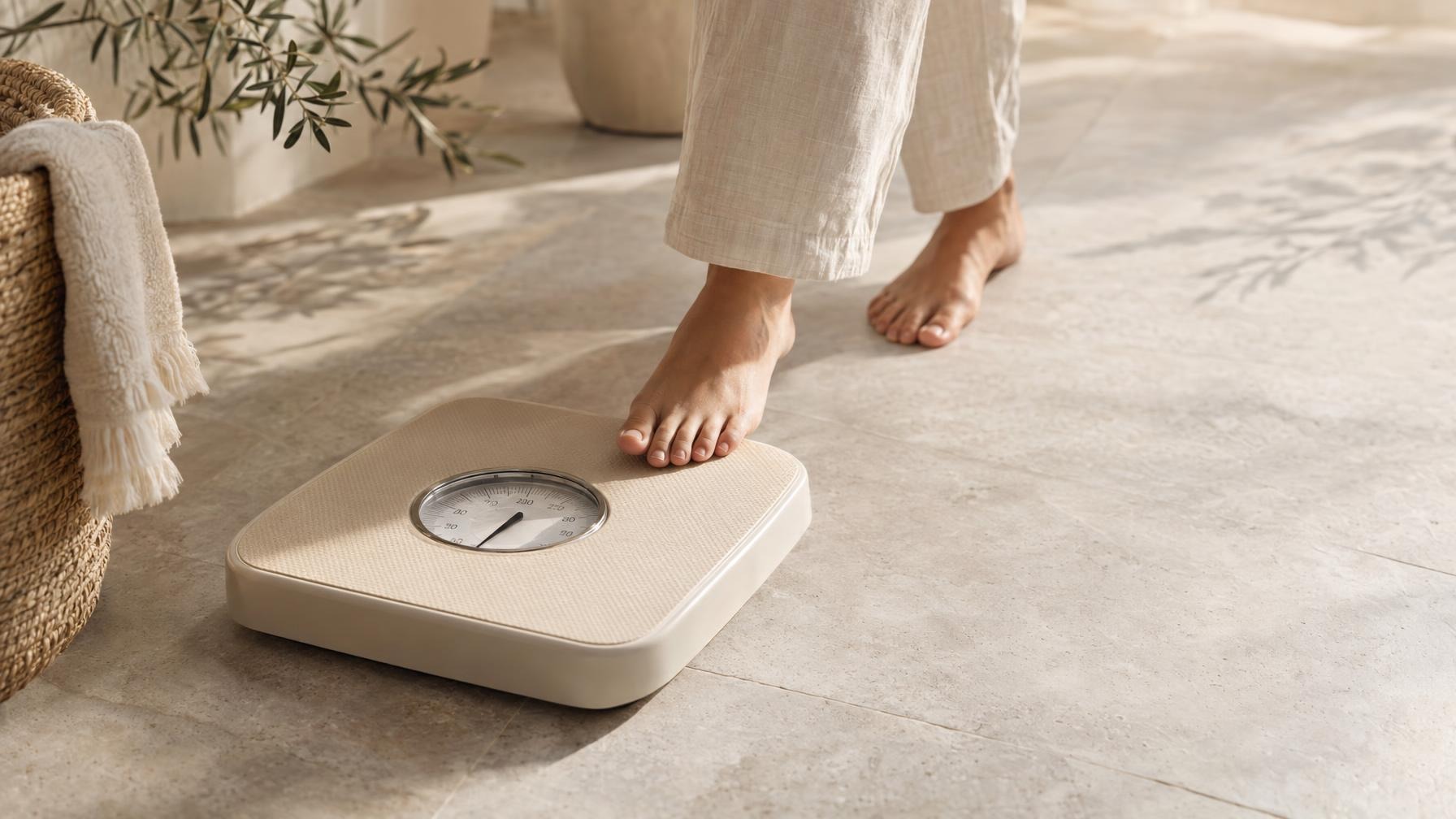
Do you gain weight because of the menopause?
Yes and no. In this stage of life your weight mainly rises because of age: your muscle mass decreases and with it your energy expenditure. What the menopause does change is where fat is stored. Because oestrogen falls, fat shifts from your hips and buttocks to your belly.
That nuance matters. "The menopause makes you fat" is an oversimplification, and so is "it's purely your hormones". If you understand which part comes from where, you also know where the gains can be made.
Why do you gain weight during the menopause?
Four mechanisms work at the same time. They reinforce each other, and that explains why weight gain during the menopause feels so stubborn.
- Less muscle mass. From your forties you gradually lose muscle tissue. Muscle burns more energy at rest than fat, so your daily energy use drops while your eating pattern stays the same.
- Falling oestrogen. This hormone influences where your body stores fat and how sensitive you are to insulin.
- Poorer sleep. Hot flushes and night sweats disrupt your sleep. Lack of sleep increases hunger and cravings for fast-acting carbohydrates.
- Less movement and more stress. Joint problems, busy working years and caring for others take movement out of your day without you noticing.
Thuisarts.nl (the Dutch GP association's patient website) offers reliable information about the menopause and the symptoms that come with it, written by GPs and medical specialists. Do you recognise that you try all sorts of things and it still doesn't work? Then it is worth reading why you are not losing weight, because the causes often go deeper than discipline.
Many women who come to us say almost word for word the same thing: "I don't eat any differently than before and yet I'm gaining weight." That feeling is not in your head. Your body has changed, your habits have not.
Hormones, oestrogen and your metabolism
Oestrogen does not determine how fast your metabolism runs, but it does determine how your body handles energy. During the menopause your ovaries produce less and less oestrogen and progesterone. That has three consequences that you notice on the scales and at your waist.
Fat storage shifts to your belly. Fat cells in the abdominal area respond differently to hormones than those on your hips. As soon as oestrogen falls, the belly becomes the preferred location.
Your insulin sensitivity decreases. Your body needs more insulin to process the same amount of blood sugar. Higher blood sugar after eating makes you hungry again sooner, so you more easily eat more than you need.
You burn less at rest. This is mainly down to the loss of muscle mass, not the hormones themselves. That is why preserving muscle is the most effective thing you can do in this phase.
The word "hormonal" is often used as the end point of the explanation. It isn't. Hormones determine the conditions under which you lose weight, not the outcome.
Why your belly in particular gets bigger
Fat around your organs is more sensitive to hormonal changes than fat under your skin. As a result your weight can barely rise while your clothes still feel tighter around your waist. This is called visceral fat, and it is medically more relevant than a few extra kilos.
The Voedingscentrum (the Netherlands Nutrition Centre) explains why belly fat poses a greater risk than fat on your hips or buttocks: it is an important risk factor for type 2 diabetes and cardiovascular disease. That makes your waist circumference a more useful measure than your weight alone.
Waist circumference thresholds for women
| Waist circumference | Meaning |
|---|---|
| Up to 80 cm | Healthy |
| 80 to 88 cm | Increased risk |
| 88 cm or more | Too high, greatly increased risk |
Source: Voedingscentrum. Measure standing, between your lowest rib and the top of your hip bone, on bare skin, with a tape measure that is not pulled too tight and after breathing out.
Measure your waist once a month alongside your weight. If your waist changes while the scales stand still, you are making progress you would otherwise miss. You can read more about tackling stubborn belly fat in our article on the menopause belly.
How many kilos do you gain on average during the menopause?
Expect about half a kilo per year in the years around the menopause. Over four to six years of menopause, that adds up to a few kilos. The research on weight gain around the menopause by Davis and colleagues in the journal Climacteric concludes that this gradual increase is attributable to age and not to the menopause itself. What the hormonal change does do is increase total body fat and belly fat in particular.
| What | What the research shows |
|---|---|
| Weight gain per year | About 0.5 kg, mainly age-related |
| Over the entire menopausal period | A few kilos, varying greatly per person |
| Change in fat distribution | More total body fat and more belly fat, hormonally influenced |
| Waist circumference | Increases measurably around the last menstrual period |
Source: Davis et al., Climacteric 2012.
Online you often see figures of five to ten kilos. These rarely come from research and more often from personal stories. If you gain considerably more than a few kilos, other factors are probably involved: medication, a thyroid problem, a greatly changed exercise pattern or a long history of dieting with a yo-yo effect.
Sudden weight gain during the menopause does not fit this picture. Several kilos in a few weeks, with fluid retention or other new symptoms, is a reason to have your GP (huisarts) take a look. Hormonal change happens gradually.
What helps against menopause weight gain?
Preserving muscle, enough protein, better sleep and realistic expectations. In this phase, investing in what you burn usually achieves more than cutting harder into what you eat. Four things do the work.
Strength training twice a week. This is the only intervention that actually protects your muscle mass and thus keeps your energy expenditure up. You can start with your own body weight.
More protein per meal. Protein keeps you full for longer and provides the building blocks for muscle repair. Spread it over the day instead of eating it all at dinner.
Take sleep seriously. Poor sleep due to hot flushes increases your hunger the next day. In this phase sleep is a weight factor, not a luxury.
Stop crash dieting. Losing weight strictly and quickly actually costs muscle mass. That lowers your metabolism and makes the next attempt harder.
What doesn't work: cutting out a single food, detox cures and supplements that promise to tackle "hormonal kilos". No food undoes the hormonal shift. A full overview of the approach is in our guide to losing weight during the menopause.
Do you recognise that you have tried everything and it still doesn't work? At Qlinic, your own BIG-registered doctor looks at your situation one to one, with a follow-up every four weeks. Take the eligibility check →
Losing hormonal kilos: diet, exercise, sleep and stress
There are no separate "hormonal kilos" that need their own method. Fat that ends up on your belly because of hormonal change disappears by the same route as other fat: a small but sustainable energy deficit, combined with preserving muscle. What does differ is how much effort that takes and how long it lasts.
Diet. Choose a pattern you can still keep up in two years. Enough protein, fibre from vegetables and wholegrain products, and fewer ultra-processed foods that go down quickly without filling you up. A regular eating rhythm keeps your blood sugar calmer than grazing on small things all day.
Exercise. Combine strength with daily basic movement. Two strength sessions plus thirty minutes of walking a day does more for your waist than three heavy cardio sessions after which you collapse on the sofa. Also read why strength training for women during the menopause makes the difference right now.
Sleep. Keep the bedroom cool, limit alcohol in the evening and try to keep a regular rhythm. Discuss persistent hot flushes with your GP, because they are treatable.
Stress. Prolonged stress raises cortisol, and that stimulates fat storage around the belly. Recovery time here is not a soft recommendation but a physiological necessity.
Give it at least three months. Change in this phase happens more slowly than in your thirties, and that says nothing about your effort.
Does hormone therapy help against weight gain?
Hormone therapy is not a weight loss drug, but it does affect your fat distribution. The review in Climacteric shows that oestrogen therapy can partly counteract the menopausal shift towards belly fat, along with better insulin sensitivity and a lower risk of type 2 diabetes. You will not lose a significant amount of weight from hormone therapy alone.
Hormone therapy is therefore prescribed for menopausal symptoms, not for weight loss. You weigh up the benefits and risks with your GP or gynaecologist. You can read more about this in our article on HRT and weight gain during the menopause.
When does medical weight loss make sense?
If you have seriously tackled your lifestyle and your weight still remains a health risk, medical supervision is a realistic next step. That does not apply to the last two kilos, but it does when overweight goes hand in hand with health problems and previous attempts have consistently failed.
In medical weight loss, a doctor looks at your whole picture: your weight history, your health, your medication and your previous attempts. Medication from the GLP-1 group is often used. GLP-1 is a natural hormone that makes you feel full; medicines that mimic this hormone reduce hunger and slow gastric emptying.
Well-known names are semaglutide (Ozempic, Wegovy, Rybelsus), tirzepatide (Mounjaro) and liraglutide (Saxenda). They are not all registered for the same purpose: some are approved for type 2 diabetes, others for weight management. Only a doctor decides which medicine is right for you and whether it is responsible.
What is known about the effect? A meta-analysis of 47 randomised studies with 23,244 participants, published in Diabetes Care in 2025, found an average of 4.57 kilos of weight loss and 4.55 centimetres less waist circumference compared with the control group. That is an average across different medicines, doses and study durations. Individual results are both higher and lower, and the effect lasts as long as the treatment and the lifestyle changes continue.
The other side of the picture: gastrointestinal symptoms are the most reported side effects, with nausea, constipation, diarrhoea and vomiting at the top. They are usually most severe while the dose is being increased. There are also situations in which this medication is not suitable or not responsible. That is why there should always be a doctor involved who knows your situation and whom you can reach if things are not going well.
Never buy these medicines without a prescription. Online offers outside a pharmacy carry a real risk of counterfeit products, the wrong dose and a complete lack of medical oversight. The legal route runs through a doctor and a registered Dutch pharmacy.
This is how it works with us. You start with a consultation and intake with your own doctor. If a programme turns out to be suitable, a prescription follows and the medication is delivered discreetly to your home by a registered Dutch pharmacy. After that you see the same doctor every four weeks; most people notice the first effect after about four weeks, mainly as reduced hunger. You can always pause or stop.
We have supported around 50 people so far and have a 5.0 rating on Google from more than twenty reviews. We are a small-scale clinic: with us you have one doctor of your own who knows your situation, and easy contact if you have doubts or experience side effects. If you want to know how such a programme works in practice, read more about medical weight loss with injections.
Gaining weight during the menopause while you have been doing your best for years? One doctor of your own, supervision every four weeks and medication delivered to your home: in a few minutes you will know whether this is right for you. Take the eligibility check →
Frequently asked questions about menopause weight gain
How many kilos do you gain during the menopause? On average about half a kilo per year, which adds up to a few kilos over the entire menopausal period. Research in Climacteric attributes this increase mainly to age and not to the menopause itself. The menopause does change your fat distribution: more fat goes onto your belly.
What can I do about weight gain during the menopause? Protect your muscle mass with strength training twice a week, eat enough protein, improve your sleep and stop crash dieting. These four together do more than eating more strictly alone, because they keep your energy expenditure up instead of lowering it further.
Why do I keep getting heavier during the menopause? Because four things happen at once: you lose muscle mass, your oestrogen falls, you often sleep worse and you move less without noticing. Your energy expenditure drops while your eating pattern stays the same. That difference only needs to be small to add up year after year.
How can I lose hormonal kilos? By the same route as other fat: a small, sustainable energy deficit combined with strength training and enough protein. There is no separate diet for hormonal kilos. What does differ is that it goes more slowly and that preserving muscle matters more than at a younger age.
What causes sudden weight gain during the menopause? Sudden weight gain does not fit hormonal change, because that happens gradually. Several kilos in a few weeks can be caused by fluid retention, medication or a thyroid condition. Have this assessed by your GP instead of starting a diet for it yourself.
Is there medication for weight gain during the menopause? There is no medicine for the menopause itself, but in the case of overweight with a health risk a doctor may consider medication from the GLP-1 group. This always happens on prescription, with supervision and alongside lifestyle changes. Never buy these medicines without a prescription outside a registered pharmacy.
Do you lose weight spontaneously again after the menopause? No, you can't count on that. After the menopause your hormones stabilise, but the lower energy expenditure and the changed fat distribution remain. Losing weight is still possible after that, but it requires a targeted approach rather than waiting.
Does hormone therapy help with losing weight during the menopause? Hormone therapy is not a weight loss drug. Research shows that oestrogen therapy can partly counteract the shift towards belly fat and improves insulin sensitivity, but it does not lead to significant weight loss. It is prescribed for menopausal symptoms, after weighing it up with your doctor.
Responsible for this information: Qlinic B.V., Markenhaven 25A, Amersfoort. Published: 25 August 2026. This article is general information and does not replace personal medical advice.
About the author
Nazanin Ahmadi Mozafari
Doctor · BIG 59925559301
Guides you from intake to follow-up and knows your file, no changing faces.
More about Nazanin Ahmadi Mozafari
Further reading

Menopause · 13 min
Menopause belly: belly fat during menopause
By Nazanin Ahmadi Mozafari, doctor
Menopause · 9 min
Strength training for women during menopause: why it works and how to start
By Nazanin Ahmadi Mozafari, doctor
Menopause · 9 min
HRT and your weight during menopause
By Nazanin Ahmadi Mozafari, doctor