
Saxenda11 min read10 August 2026
Saxenda dosage: the full dosing schedule and how to use the pen
If losing weight doesn't work despite diets and exercise, your doctor may prescribe Saxenda. You will then want to know exactly how to use it: how to build up, when to inject and what to do if things don't go smoothly. The answer starts with the fixed dosing schedule: you start with 0.6 mg per day and increase the dose by 0.6 mg every week until you reach 3.0 mg per day.
 By Nagita Grover-Khatri
 Medically reviewed by Nazanin Ahmadi Mozafari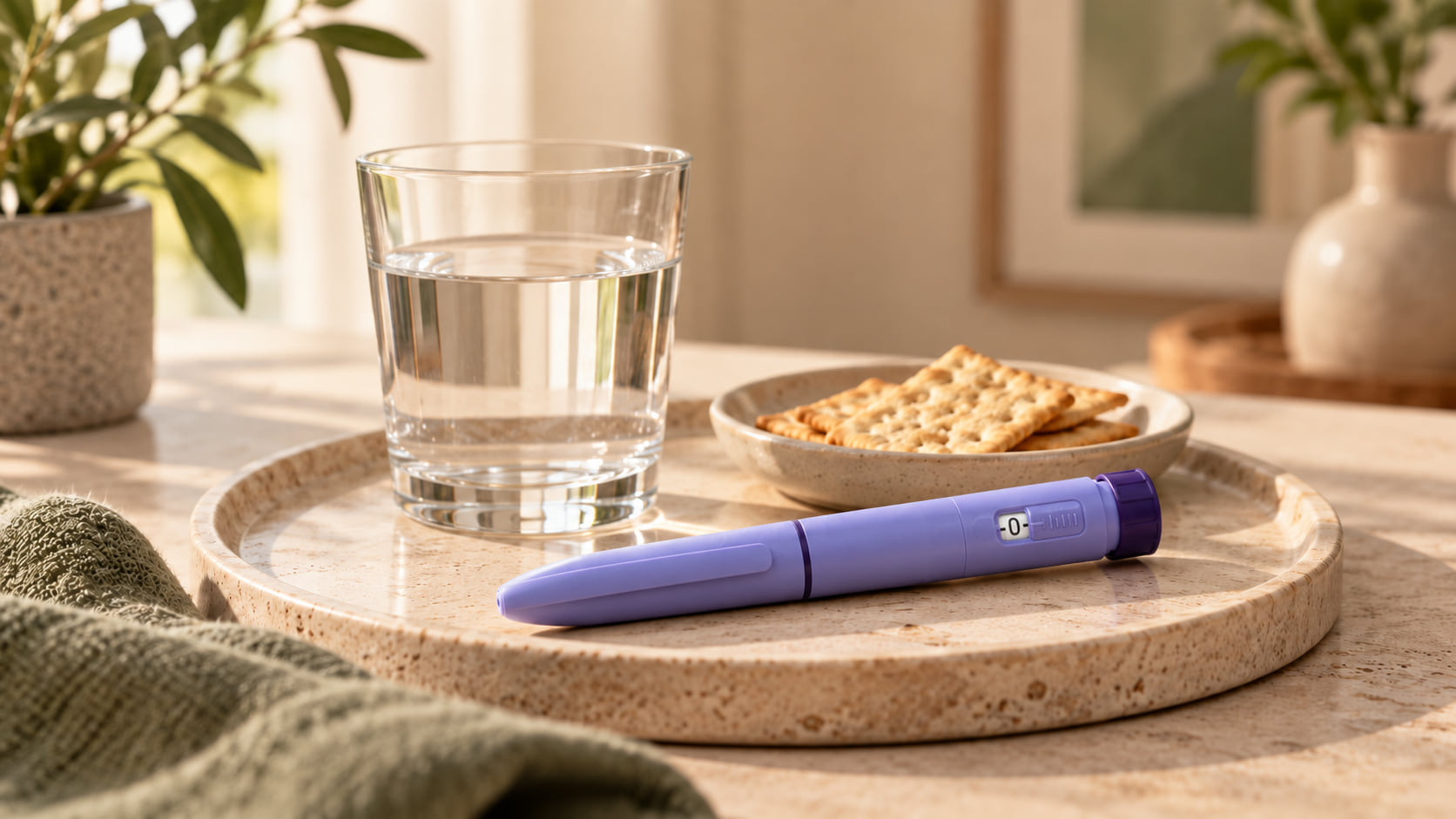
What is the Saxenda dosing schedule?
The Saxenda dosing schedule starts at 0.6 mg per day. You increase the dose by 0.6 mg every week until, after 5 weeks, you reach the maintenance dose of 3.0 mg per day. This gradual build-up gives your body time to adjust and limits side effects such as nausea. Read more about Saxenda side effects.
Below you will find the complete schedule per week, the instructions for the pen, the 12-hour rule for a missed dose, and clear answers about side effects, alcohol and results. Do you recognise the feeling that you have already tried everything? Then also read why you are not losing weight.
The Saxenda dosing schedule per week
The dosing schedule goes from 0.6 to 3.0 mg per day in five steps, with at least one week per step. This is what it looks like:
| Week | Dose per day |
|---|---|
| Week 1 | 0.6 mg |
| Week 2 | 1.2 mg |
| Week 3 | 1.8 mg |
| Week 4 | 2.4 mg |
| Week 5 onwards | 3.0 mg (maintenance dose) |
The build-up is not a formality but the core of the treatment. Saxenda contains the active ingredient liraglutide, a GLP-1 medicine that mimics a natural gut hormone. It slows your gastric emptying and reduces your feeling of hunger.
Precisely because it acts on your stomach and intestines, your body needs time to adjust. According to the official product information from the European Medicines Agency (EMA), the dose is therefore increased slowly over at least 4 weeks.
Two practical rules for the build-up:
- Slower is allowed, faster is not. If you suffer a lot from nausea, your doctor may decide that you stay on the same dose for an extra week. Never skip a step on your own initiative.
- The build-up is individual. Some people feel fine on 3.0 mg, others need more time. Always consult your doctor before changing anything about your dose.
Once you are on 3.0 mg, you stay on that maintenance dose for as long as the treatment lasts. A daily dose higher than 3.0 mg is not permitted.
How to use the Saxenda pen: instructions in 7 steps
Saxenda is an injection you give yourself once a day with a prefilled pen, just under the skin. That sounds more daunting than it is: the needles are thin and short, and most people get the hang of it within a few days.
This is how the Saxenda pen works:
- Check the pen. The liquid should be clear and colourless. Also check the expiry date.
- Screw a new needle onto the pen. Use a new needle for every injection.
- Check the flow with a new pen. The first time you use each pen, check that a drop of liquid comes out of the needle.
- Set your dose. Turn the dose selector to the dose for your week of the dosing schedule.
- Inject into your abdomen, thigh or upper arm. Pinch a fold of skin and insert the needle straight in.
- Press the button and count to 6. That way you can be sure the full dose has been delivered.
- Remove the needle and dispose of it in a sharps container.
Rotate the injection site to prevent skin irritation. If you always inject into your abdomen, for example, choose a slightly different spot each time. Store new pens in the fridge; the pen you are using may stay out of the fridge for up to a month, provided it is kept below 30 degrees. You will find the full instructions in the official Saxenda patient information leaflet from the College ter Beoordeling van Geneesmiddelen (CBG, the Dutch Medicines Evaluation Board).
What is the best time to use Saxenda?
There is no medically prescribed time: you can inject Saxenda at any time of day, with or without food. What is fixed: choose one set time and stick to it. Liraglutide works for about 24 hours, so a fixed injection time keeps the level in your body stable.
Practical tips from our supervision:
- Link the injection to a fixed habit, such as brushing your teeth in the morning or evening. That makes you less likely to forget it.
- Do you suffer from nausea during the day? Some people find the build-up phase easier when they inject in the evening. Discuss this with your doctor.
- Choose a time you can manage every day, including at weekends and on holiday.
How many days does one Saxenda pen last?
One Saxenda pen contains 18 mg of liraglutide. How long it lasts therefore depends on your daily dose: from 30 days in week 1 to 6 days on the maintenance dose.
| Daily dose | Number of days per pen |
|---|---|
| 0.6 mg (week 1) | 30 days |
| 1.2 mg (week 2) | 15 days |
| 1.8 mg (week 3) | 10 days |
| 2.4 mg (week 4) | 7 days |
| 3.0 mg (maintenance) | 6 days |
For the full 4-week build-up phase you use about 42 mg in total, so around 2.5 pens. On the maintenance dose of 3.0 mg per day you then use about 5 pens per month. Useful to know for your planning: make sure you have new pens at home before the current one is empty, so you don't have to skip a day.
Missed a dose? This is how the 12-hour rule works
Have you forgotten an injection and was it less than 12 hours ago? Then take the dose anyway. If more than 12 hours have passed, skip the dose and inject the next day at your usual time. Never take a double dose to make up for a missed injection.
A single missed day is not a disaster: the effect of liraglutide lasts about a day and your schedule simply continues.
It is different if you have not injected for three days or longer. The level in your body has then dropped and side effects can be more severe when you restart. The guideline is then to build up again from 0.6 mg in consultation with your doctor. In that case, contact your doctor first before you continue injecting.
Side effects during the build-up phase
The most common side effects of Saxenda are nausea, diarrhoea, constipation and vomiting. According to the EMA, they occur in more than 1 in 10 users, especially in the first weeks and around a dose increase. For most people, the symptoms ease within a few days to weeks as the body adjusts.
That adjustment is exactly why the dosing schedule exists. Still, there is a lot you can do yourself to make the build-up phase more comfortable:
- Eat smaller portions and stop eating as soon as you feel full. Because of how the medicine works, that full feeling comes sooner than you are used to.
- Avoid fatty and heavy food in the first weeks; it makes the nausea worse.
- Drink enough water, especially with diarrhoea or vomiting.
- Build up slowly. Having a lot of trouble? Your doctor can postpone a build-up step by a week.
There are also rare but serious side effects, such as inflammation of the pancreas or gallstones. If you get severe, persistent abdominal pain, contact your doctor immediately. You can read a complete overview per medicine group in our article on GLP-1 side effects.
Our experience: side effects are rarely a reason to stop, but they are a reason to ask your questions. At Qlinic you discuss symptoms with your own BIG-registered doctor, so you are not left walking around with unanswered questions.
Nervous about the build-up phase? At Qlinic, your own BIG-registered doctor supports you personally, including with any side effects along the way. Take the eligibility check →
Saxenda and alcohol
Alcohol is not forbidden while using Saxenda, but moderation is wise. Apotheek.nl advises a maximum of one glass a day, with something to eat (Apotheek.nl is the Dutch pharmacists' patient information website). Alcohol can cause low blood sugar, and during this treatment your body recovers from that more slowly.
There are two more practical reasons to be cautious. Alcohol can worsen the gastrointestinal symptoms of the build-up phase, and alcoholic drinks provide a lot of calories without nutritional value, which slows your weight loss. Many users also notice that their desire for alcohol decreases by itself, just like their appetite for food. If you also take diabetes medication alongside Saxenda, always talk to your doctor about alcohol first. Read more about Saxenda and alcohol.
How much weight do you lose with Saxenda, and when do you stop?
In the largest scientific study of Saxenda, the SCALE trial among 3,731 participants, users lost an average of 8.4 kg in 56 weeks, compared with 2.8 kg in the placebo group. More than 63% of users lost at least 5% of their body weight. Important to add: all participants combined the medicine with dietary and exercise advice. Saxenda is an aid that takes away the feeling of hunger, not a miracle cure.
How much weight you lose varies per person and depends on your starting point and your lifestyle. That is why Saxenda has a built-in evaluation: the 5% stopping rule. If, after 12 weeks on the full dose of 3.0 mg, you have lost less than 5% of your body weight, the guideline is to stop the treatment. The medicine is then not working well enough for you, and continuing makes no sense from a medical point of view.
That sounds strict, but it protects you from months of injecting without results. If Saxenda does not work well enough, your doctor will look at alternatives with you; there are more medicines in this group. You can read how they compare in Saxenda vs Ozempic.
Medical weight loss with injections at Qlinic
Saxenda is available on prescription only, and that is a good thing. A doctor assesses in advance whether the medicine suits your health, sets the dosing schedule and monitors your progress. Never buy Saxenda online without a prescription: it is illegal, and you run a real risk of counterfeit medicines without the active ingredient or with harmful contents.
This is how it works at Qlinic. You start with the online eligibility check and an intake consultation with your own BIG-registered doctor. If medical weight loss with injections or another GLP-1 programme is right for you, the doctor writes the prescription and the medication is delivered to your home.
After that you see or speak to the same doctor every 4 weeks, who personally follows your dosing schedule and results. Most people notice the first effect after about 4 weeks: the constant feeling of hunger decreases.
We believe in realistic guidance, not promises. If you have doubts during the build-up phase, you simply discuss them with your doctor. So far we have helped around 50 people in this way, and on Google clients rate us 5.0 (more than 20 reviews).
Curious what a programme costs? See the Saxenda cost at Qlinic.
Not managing to lose weight on your own and want to know whether Saxenda is right for you? Complete the no-obligation eligibility check and our doctor will personally assess whether medical weight loss is an option for you. Take the eligibility check →
Frequently asked questions about the Saxenda dosing schedule
What is the injection schedule for Saxenda?
The Saxenda injection schedule is one injection per day, at a fixed time of your choice. You start in week 1 with 0.6 mg per day and increase by 0.6 mg every week until you reach the maintenance dose of 3.0 mg per day in week 5. You never increase faster than one step per week. Read more about how fast Saxenda works.
How much weight can you lose in 3 months with Saxenda?
That varies per person, but the medical guideline is at least 5% of your body weight after 12 weeks on the full dose. If you don't reach that, the treatment is stopped. In the SCALE trial, users lost an average of 8.4 kg in 56 weeks, combined with dietary and exercise advice.
How many days does 1 Saxenda pen last?
One pen contains 18 mg of liraglutide. In week 1 (0.6 mg per day) it lasts 30 days; on the maintenance dose of 3.0 mg per day a pen is empty after 6 days. On the full dose you therefore use about 5 pens per month.
What is the best time to use Saxenda?
There is no best time: Saxenda works for about 24 hours and can be used at any time of day, with or without food. Do choose one fixed time and keep to it every day. Many users link the injection to a fixed habit, such as brushing their teeth in the morning or evening.
Responsible for this information: Qlinic B.V., Markenhaven 25A, Amersfoort. Published: 10 August 2026. This article is general information and does not replace personal medical advice.
About the author
Nagita Grover-Khatri
Doctor · BIG 39912467601
Focuses on medical programmes for overweight, with attention to the person behind the numbers.
More about Nagita Grover-Khatri
Further reading

Saxenda · 11 min
Liraglutide: Saxenda, Vobexoryn, Nevolat, Diavic and Byesilor compared
By Nazanin Ahmadi Mozafari, doctor

Weight loss medication · 8 min
GLP-1 side effects: a clear overview
By Nazanin Ahmadi Mozafari, doctor
Saxenda · 8 min
Saxenda cost: what you pay per month in 2026
By Nazanin Ahmadi Mozafari, doctor