
ResearchReport, version 126 November 2026
Mounjaro study 2026: what 2,397 users report about appetite, side effects and weight
Summary
Of the people who use Mounjaro (tirzepatide) to lose weight and write about their appetite, 98% mention less appetite; for 17% that effect sometimes wears off. Of those who describe their side effects, 31% mention nausea; 16% of those who rate the severity describe their symptoms as severe. After three to six months the weight loss users report is around 16.5% (median). Of those who give an overall verdict, 89% are positive; with severe side effects that is 28%. This comes from our analysis of 2,397 public experiences, set against official reports and clinical studies.
1The main findings
- 98% of people using it for weight loss who write about their appetite mention less appetite (382 of 390).
- For 17% of them the effect sometimes wears off, for example in the days before the next injection.
- 31% of people using it for weight loss who describe their side effects mention nausea. In the registration study SURMOUNT-1 it was 33% at 10 mg.
- Users mention diarrhoea five times less often than the study measured: 4% versus 21%.
- 89% of people using it for weight loss who give a verdict are positive. With severe side effects that is 28%.
- After three to six months users report a weight loss of 16.5% (median).
- 10% write that they have stopped; 44% of them mention cost or losing reimbursement.
- In the United States 68% of people using it for weight loss mention cost, in the United Kingdom 44%.
2The key figures
Figure 1
98% mention less appetite. Almost nine in ten are positive.
Key figures from the public experiences of 1,030 people who use Mounjaro (tirzepatide) to lose weight. Each figure has its own denominator: the percentage who mention something, not the percentage who have it.
98%
mention less appetite
margin 96% to 99%
of 390 people who write about their appetite
89%
are positive about the medicine
margin 86% to 91%
of 851 people who give an overall verdict
31%
mention nausea
margin 27% to 36%
of 371 people who describe their side effects
16%
describe their side effects as severe
margin 12% to 20%
of 308 people who rate the severity
16.5%
weight loss after 3 to 6 monthsmedian of what users report
middle half 12% to 22%
of 52 people who report weight and period
10%
say they have stopped44% of them because of cost or reimbursement
margin 9% to 12%
of 1,030 people using it for weight loss
17%
say the effect wears offbefore the next injection or after a while
margin 13% to 21%
of 390 people who write about their appetite
View as table
| What users mention | Share | 95% margin | Of whom |
|---|---|---|---|
| mention less appetite | 97.9% | 96% to 99% | 390 people who write about their appetite |
| are positive about the medicine | 88.7% | 86.4% to 90.7% | 851 people who give an overall verdict |
| mention nausea | 31.3% | 26.8% to 36.2% | 371 people who describe their side effects |
| describe their side effects as severe | 15.9% | 12.2% to 20.4% | 308 people who rate the severity |
| weight loss after 3 to 6 months (median of what users report) | 16.5% | middle half 12.2% to 21.5% | 52 people who report weight and period |
| say they have stopped (44% of them because of cost or reimbursement) | 10.3% | 8.6% to 12.3% | 1,030 people using it for weight loss |
| say the effect wears off (before the next injection or after a while) | 16.7% | 13.3% to 20.7% | 390 people who write about their appetite |
Source: Qlinic, Mounjaro study 2026, n = 1,030 people using it for weight loss. Public posts on Bluesky and Flashback, coded per user. Bar: share with 95% margin (lighter part). Weight loss: median of what users report themselves; the bar shows the middle half on a scale of 0 to 40% of starting weight. Other bars run from 0 to 100%.
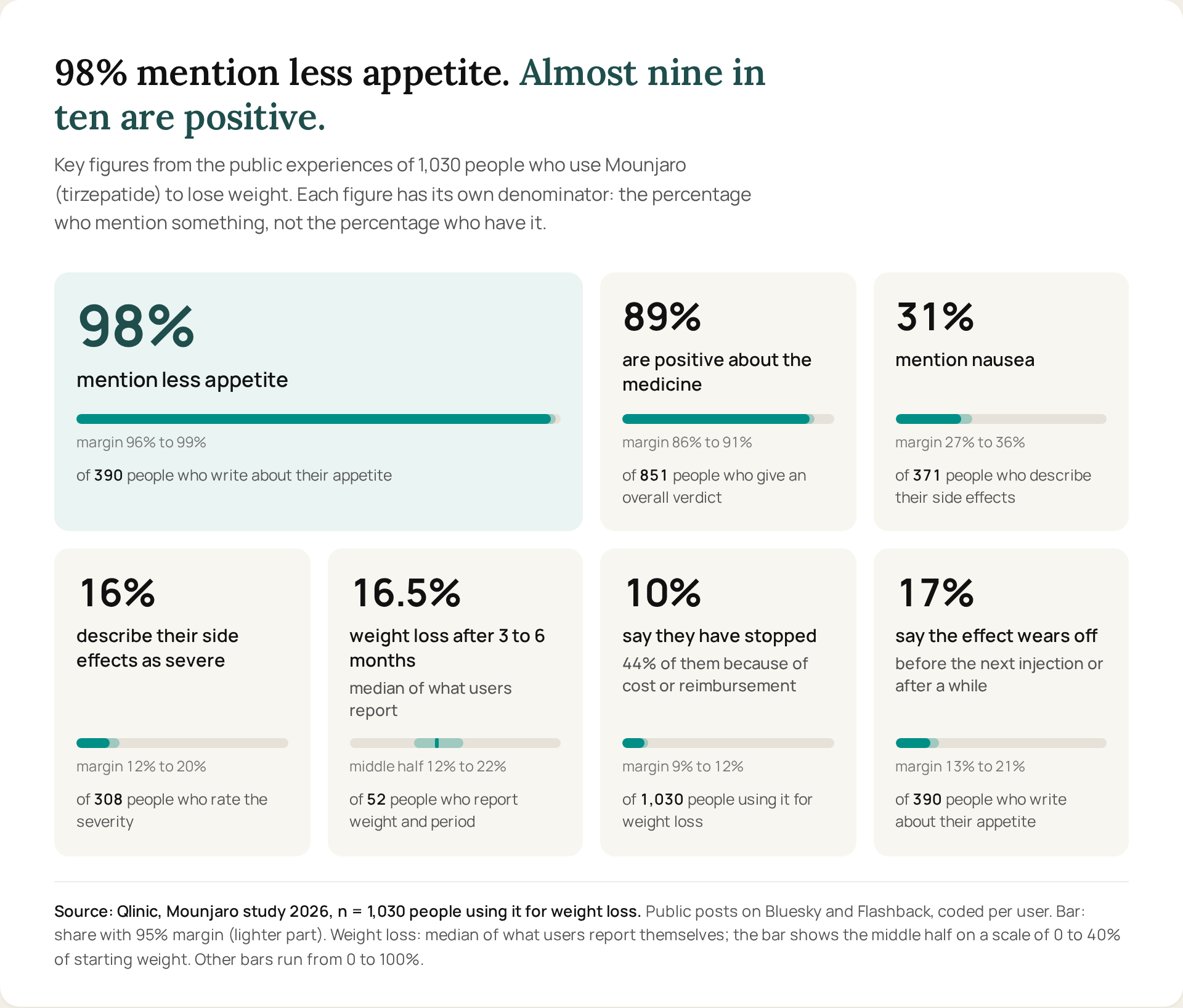
A percentage here means: this percentage mentions it. Someone who does not mention something may still have had it. So these figures do not tell you how often something happens to everyone who uses Mounjaro; only clinical studies show that.
3Who the users in this study are
We analysed public posts from 2,397 people who use tirzepatide themselves: 2,247 on Bluesky and 150 on the Swedish forum Flashback. Tirzepatide is the active substance in Mounjaro; in the United States the same substance for weight loss is also sold as Zepbound.
- 1,030 use it to lose weight and 367 for type 2 diabetes; 124 give another reason and for 876 the reason is not in their posts.
- 86% use the manufacturer's pen (Mounjaro or Zepbound).
- Most writers live in the United States or the United Kingdom; the Flashback group is from Sweden.
Because the aim of the treatment affects what people notice, the figures on this page are about the weight loss group unless stated otherwise.
4The biggest theme: food and appetite
Figure 2
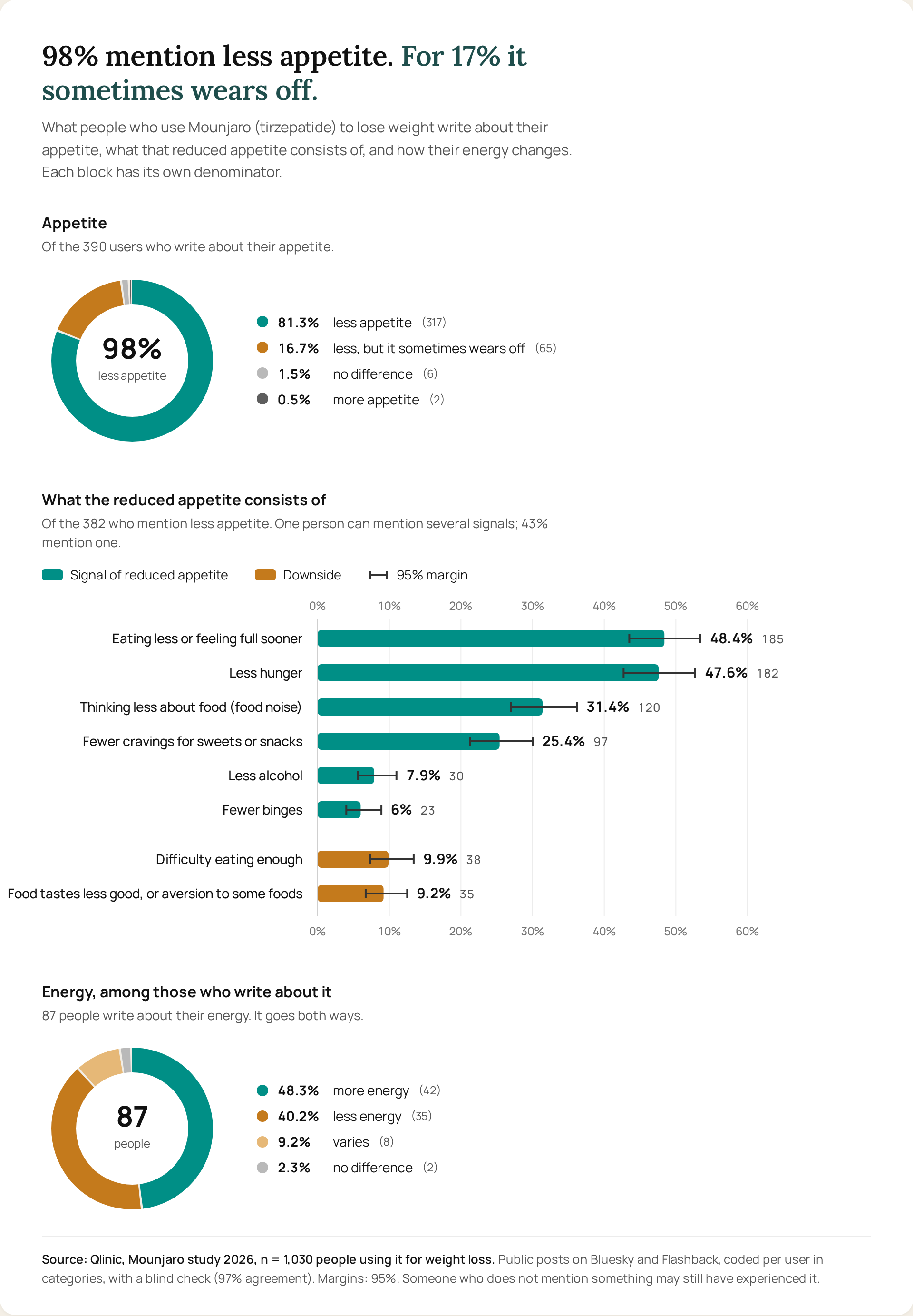
390 people using it for weight loss write something about their own appetite. Of them, 98% mention less appetite: 81% without qualification and 17% noting that the effect sometimes wears off, in the days before the next injection or after a few weeks or months. 6 people write that their appetite did not change and 2 that it increased.
What does that reduced appetite consist of? Of the 382 who mention it:
- 48% eat less, take smaller portions or feel full sooner;
- 48% have less hunger;
- 31% think less about food, which many users call "food noise";
- 25% have fewer cravings for sweets and snacks;
- 8% drink less alcohol;
- 6% have fewer binges.
Most describe it in more than one way; 43% mention one signal. There is also a downside: 10% find it hard to eat enough and 9% find food less tasty or develop an aversion to certain foods.
Energy goes both ways. Of the 87 people using it for weight loss who write about their energy, 48% mention more energy, 40% less energy and 9% that it varies, for example tiredness in the days after the injection.
Besides food and energy, users mention wellbeing and health: a better mood, self-image or quality of life (17% of the 650 who describe what the medicine does for them), better blood sugar, blood pressure or cholesterol (12%) and less pain or inflammation (7%).
5Side effects: users, reports and study side by side
Figure 3
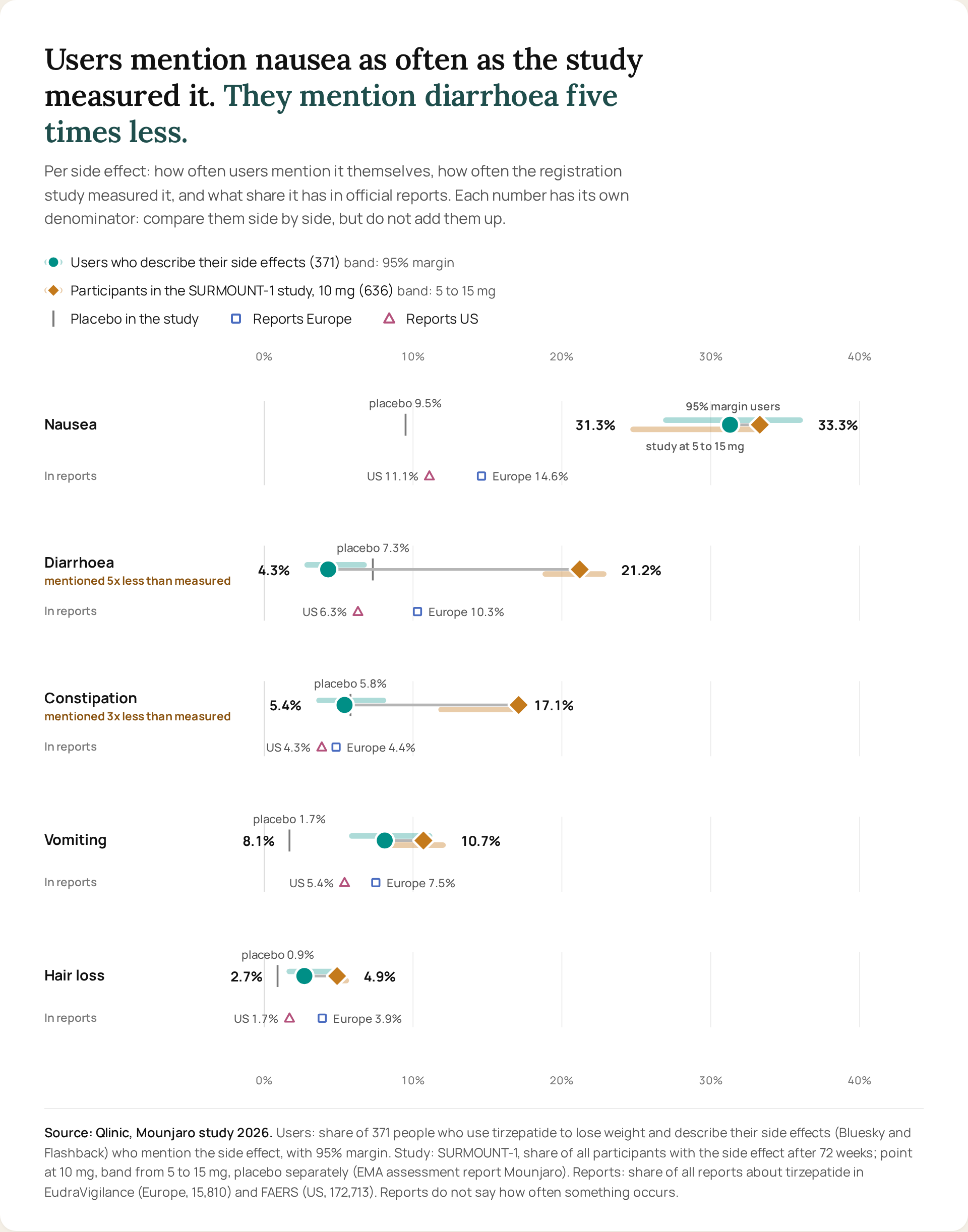
Of the 371 people using it for weight loss who describe their side effects, 84% mention at least one. Nausea is by far the most common (31%), followed by tiredness (12%), vomiting (8%), burping or sulphur burps (6%), reflux or heartburn (6%), headache (5%), constipation (5%) and feeling cold (5%). Of those who rate the severity, 45% describe their symptoms as mild, 40% as bothersome and 16% as severe.
How does that compare with other sources? For nausea:
| Source | Nausea | What the number is |
|---|---|---|
| This study, weight loss group | 31% | of users who describe side effects |
| Reddit analysis (Sehgal et al., 2026) | 29% | of tirzepatide users who report a side effect |
| SURMOUNT-1, 5 / 10 / 15 mg | 25% / 33% / 31% | of all participants in the study (placebo 10%) |
| EudraVigilance, Europe | 15% | of all reports about tirzepatide |
| FAERS, United States | 11% | of all reports about tirzepatide |
What users describe about nausea is close to what the registration study showed. In the official reports nausea is lower, because they also contain many other kinds of reports, such as administration errors.
Two things stand out in the experiences but not in the reports: feeling cold (5%) and burping or sulphur burps (6%) are mentioned by users more often than their share of reports would suggest. Gallbladder or pancreas problems are mentioned by fewer than 1% of the people using it for weight loss who describe side effects (5 of the 371); these appear relatively more often in reports, where healthcare professionals mainly pass on serious cases.
In these experiences, people on a low dose (2.5 to 5 mg) do not mention side effects less often than people on a high dose (12.5 to 15 mg). The numbers per dose are small; this is a signal, not a conclusion.
6What the overall verdict is linked to
Figure 6
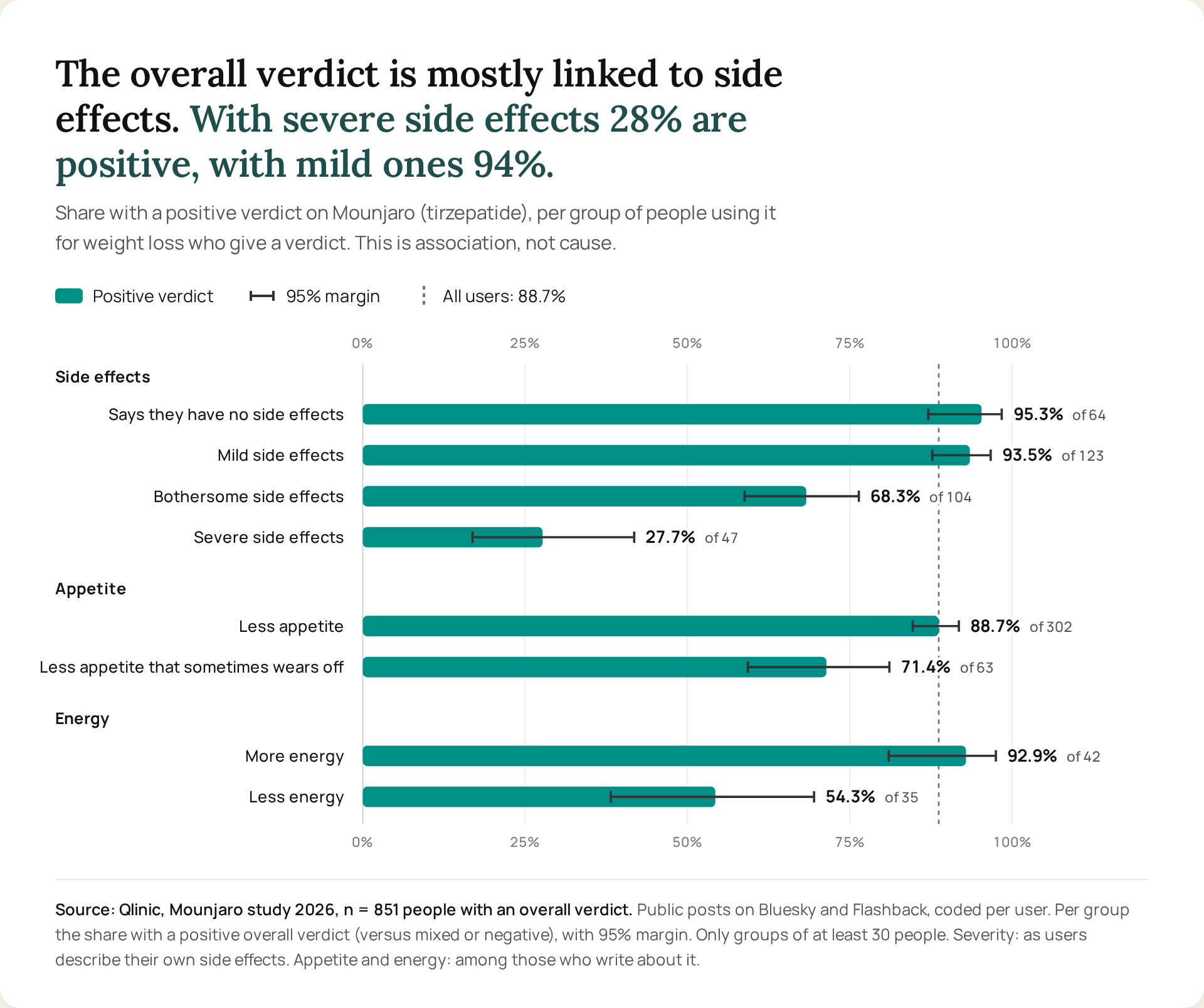
Of the people using it for weight loss who give a verdict, 89% are positive. That verdict is mostly linked to side effects: with mild side effects 94% are positive, with bothersome ones 68% and with severe ones 28%. People who say they have no side effects are 95% positive.
There is also a difference for appetite and energy. People who mention less appetite are 89% positive; if that effect sometimes wears off, 71%. People who mention more energy are 93% positive; those who mention less energy, 54%.
These are associations in what people write, not causes. The margins are shown in the figure.
7Weight loss per period
Figure 4
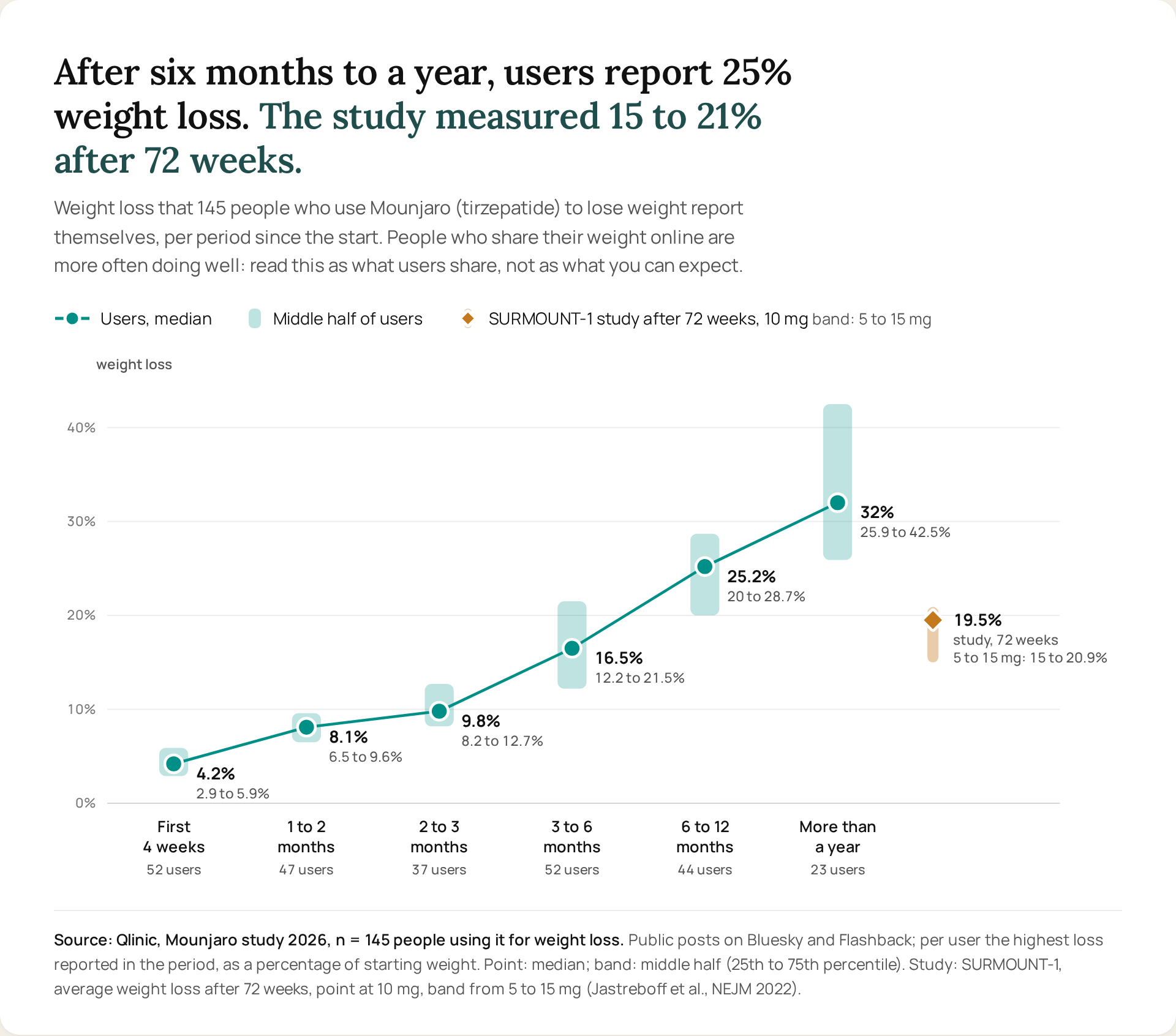
145 people using it for weight loss report enough to calculate their weight loss as a percentage. For each person the highest loss reported in the period counts.
| Period since the start | People | Median loss | Middle half |
|---|---|---|---|
| First 4 weeks | 52 | 4% | 3 to 6% |
| 1 to 2 months | 47 | 8% | 7 to 10% |
| 2 to 3 months | 37 | 10% | 8 to 13% |
| 3 to 6 months | 52 | 16.5% | 12 to 21.5% |
| 6 to 12 months | 44 | 25% | 20 to 29% |
| More than a year | 23 | 32% | 26 to 42.5% |
In the registration study SURMOUNT-1, participants lost an average of 15% (5 mg), 19.5% (10 mg) and 21% (15 mg) after 72 weeks. The figures from experiences are higher. That is to be expected: people who share their weight online are more often doing well. So read this table as what users share, not as what you can expect.
8Why people stop or switch
Figure 5
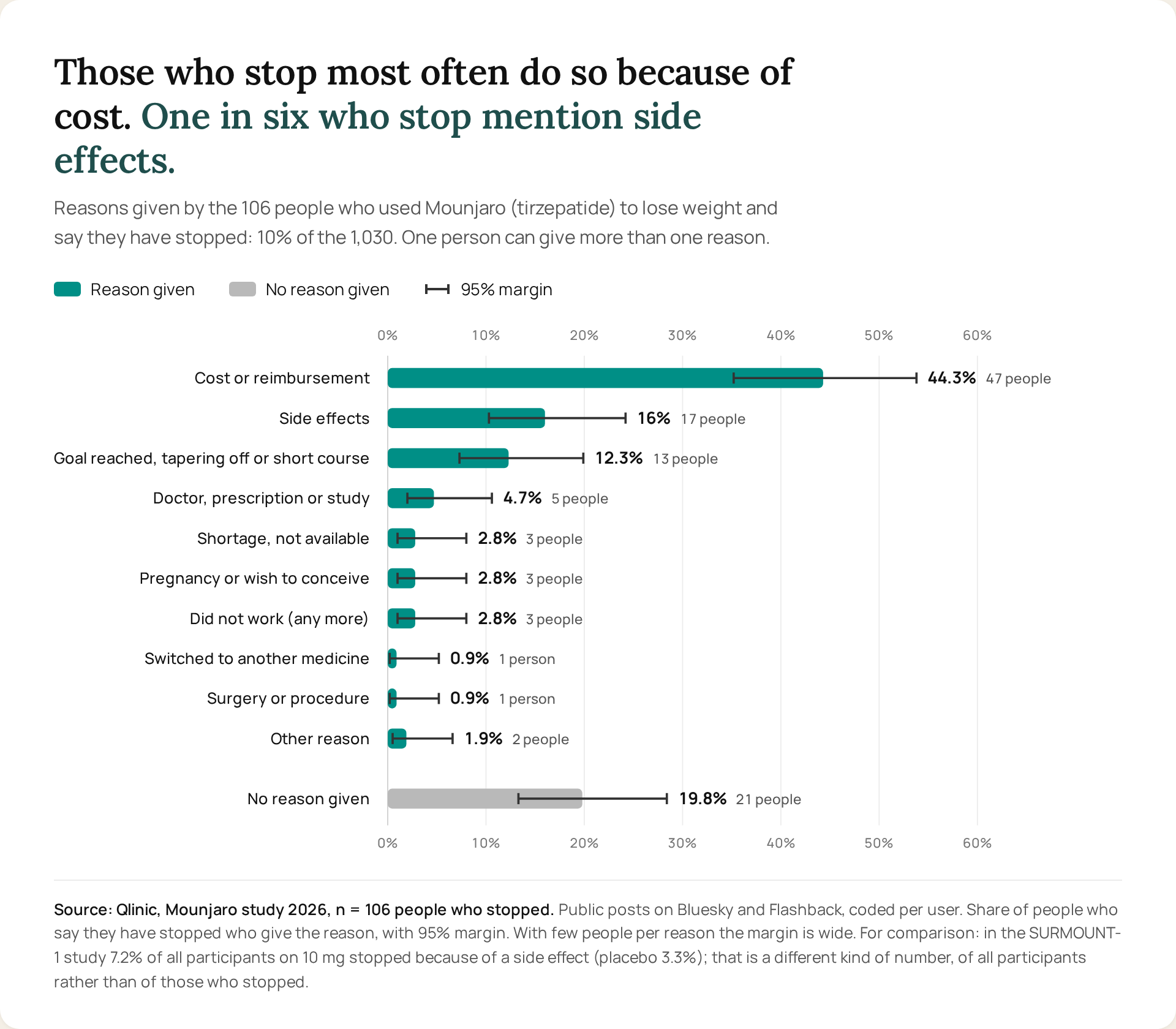
10% of the people using it for weight loss write that they have stopped. Of them, 44% mention cost or losing reimbursement, 16% side effects and 12% that they reached their goal or are deliberately tapering off; 20% give no reason. Cost mainly plays a role for American users whose insurance stopped covering it. Of the people from the United States, 68% mention cost, in Sweden 57% and in the United Kingdom 44% (the country is known for 415 of the 1,030).
Figure 7
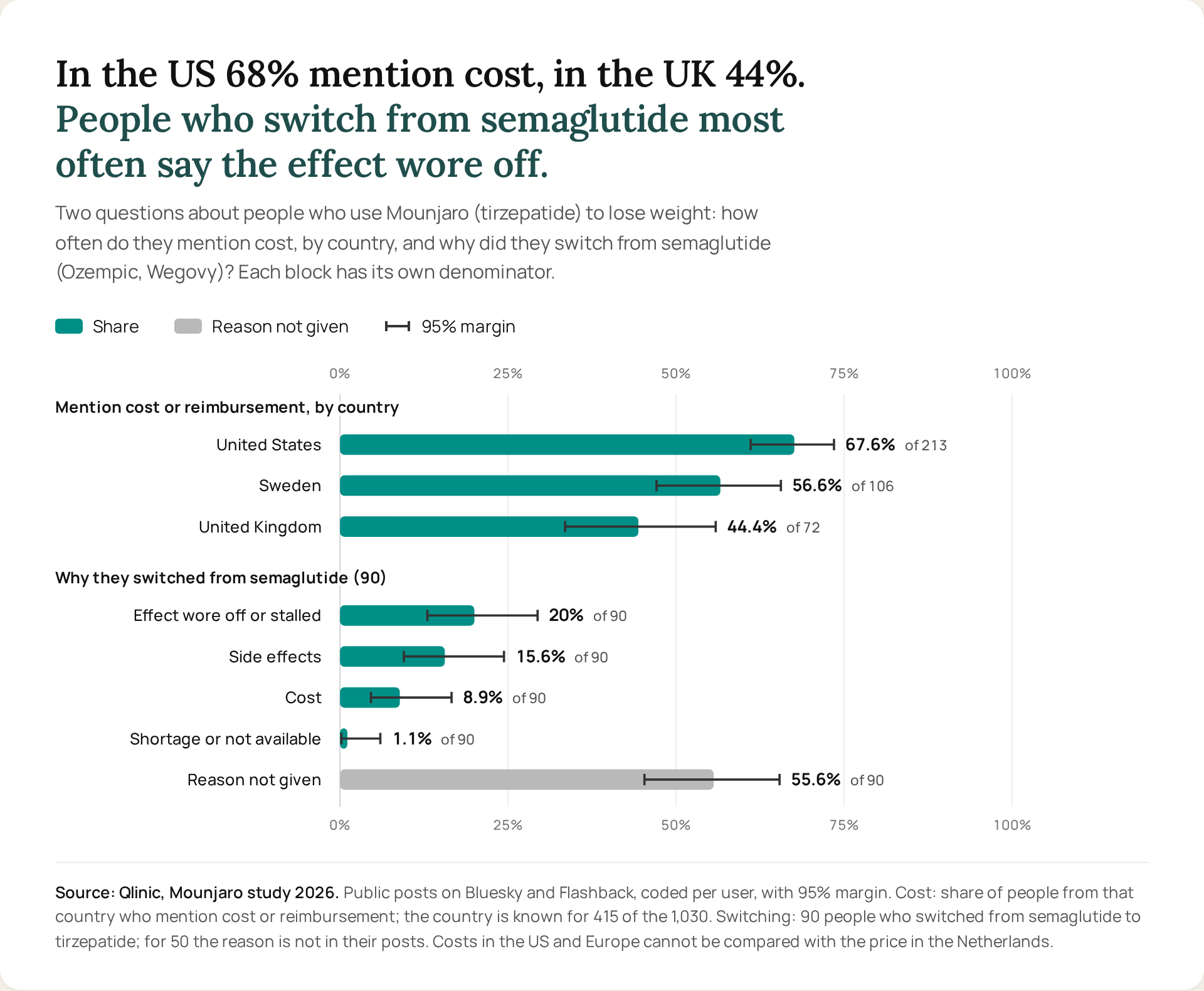
90 people switched from semaglutide (Ozempic or Wegovy) to tirzepatide. Those who give a reason mainly say that the effect of semaglutide wore off or their weight stalled (18), then side effects (14) and cost (8); for 50 the reason is not in their posts. People who switched are as often positive about tirzepatide as the rest (85% versus 89%, within the margins). 34 went the other way, often because of cost.
8% mention a plateau: a period in which their weight stops going down.
9With diabetes the emphasis is different
Of the 266 users with type 2 diabetes who describe what the medicine does for them, 73% mention better blood sugar, blood pressure or cholesterol. 23% of them mention less hunger, less often than in the weight loss group. They mention nausea about as often (29%).
10How this study was done
Sources. Public posts on Bluesky (38,098 posts mentioning mounjaro, tirzepatide or zepbound, July 2023 to November 2026, collected through Bluesky's official access) and the Flashback thread on tirzepatide (1,536 posts, January 2024 to November 2026). Other forums and platforms were left out because their terms do not allow this use. In addition, official reports of suspected side effects from EudraVigilance (EMA, 15,810 reports from the European Economic Area) and FAERS (FDA, 172,713 reports), published studies and the registration study SURMOUNT-1.
Unit. One respondent is one writer. All posts by the same writer together form one profile. Names were replaced by a random code when the posts were collected; no posts or names have been published.
Coding. Each profile was coded using a fixed codebook: product, reason for use, 19 side effects (mentioned, explicitly denied or not mentioned), severity, effects on food, wellbeing and health (26 categories), weight with period and dose, stopping, switching and overall verdict. Only what writers say about their own use counts. Profiles where own use was uncertain were left out.
Check. A sample of 186 profiles was coded again, blind. Agreement per fixed field was between 85% and 100%; for the open categories on food and wellbeing both coders arrived at the same category in 75% of cases.
Second round: appetite and energy. To also count people who notice no effect, appetite and energy were coded separately for all 1,030 people using it for weight loss: less appetite, less but it sometimes wears off, no difference, more, or nothing said; for energy more, less, varies, no difference or nothing. A blind check on 90 profiles arrived at the same category in 97% of cases for appetite and 99% for energy. Mentioning only less alcohol does not count as less appetite.
What it is not. This is not a clinical study and does not measure effectiveness. People who write online are not a cross-section of all users; people who are doing well or have a problem write more often. People who notice nothing about their appetite rarely write about it: of the 390 who wrote about their appetite, 6 reported no difference. Reports of side effects do not prove a link with the medicine and say nothing about how often something happens. Each number has its own denominator; do not add up numbers from different sources.
Carried out by Qlinic, a clinic for medical weight loss in Amersfoort and Zoetermeer. Data as of 25 November 2026.
11For journalists
The figures and charts are published under the CC BY 4.0 licence: you may reuse them with a source credit and a link to this page. Every chart has its own buttons: download as PNG, embed on your site and cite.
Citation
Qlinic (2026). Mounjaro study 2026: what 2,397 users report about appetite, side effects and weight. qlinic.nl/en/knowledge/research/mounjaro-2026
Download the press kit
All seven charts as PNG and all figures as CSV, in one zip.
Download the figures (CSV)
The numbers behind every chart, with denominator and margin. No posts and no names.
Media contact
Questions about the study or the figures? Contact Qlinic.
info@qlinic.nl · 085 760 6121
12Frequently asked questions
How many Mounjaro users get side effects?
In the registration study, most participants had at least one gastrointestinal complaint. In this study, 84% of the people using it for weight loss who describe their side effects mention at least one, usually nausea; 16% of those who rate the severity describe them as severe.
What do Mounjaro users mention most often?
Less hunger and feeling full sooner are the effects users mention most often.
Does Mounjaro affect appetite?
Of the users who write about their appetite, 98% mention less appetite. For 17% that effect sometimes wears off, for example in the days before the next injection.
How much weight do you lose on Mounjaro according to users?
Users who share their figures report a median of 16.5% after three to six months. That is higher than the average in studies, because mainly people who are doing well share figures.
Why do people stop taking Mounjaro?
Mainly because of cost or losing reimbursement (44% of those who stop), followed by side effects (16%).
More about medical weight loss with injections.
Responsible for this information: Qlinic B.V., Markenhaven 25A, Amersfoort. Published: 26 November 2026. This study is general information and does not replace personal medical advice.